What the picture shows
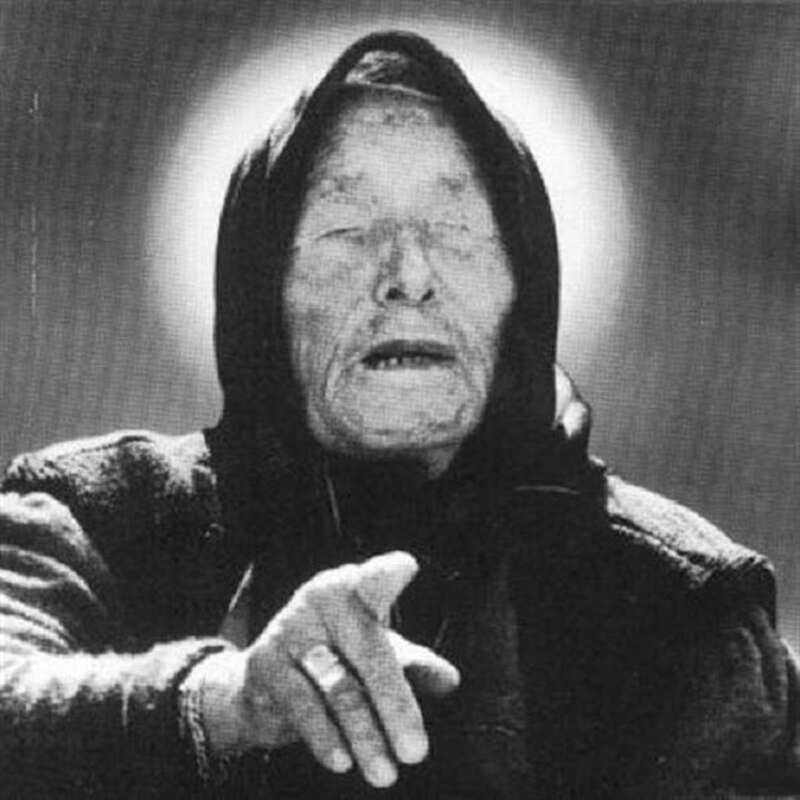
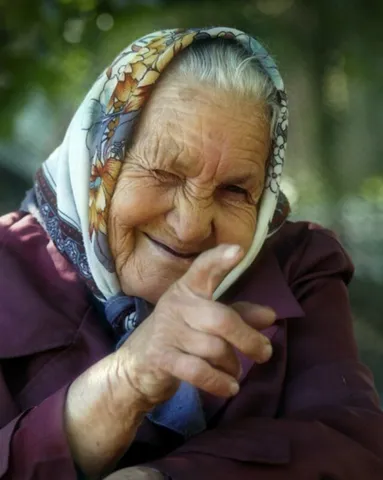
The photo is a black-and-white portrait of an elderly woman in a dark headscarf pulled low over her forehead. Her eyes are closed, her face is covered in deep wrinkles, and an outstretched hand with a ring on the finger points directly at the viewer. A soft, light glow radiates around her head and shoulders, separating the figure from the dark background and creating a sense of solemnity.
It's exactly this pose and lighting that make the shot so recognizable: it's the image of a person who supposedly sees more than others. The pointing-finger gesture reads as a visual verdict, which makes the picture convenient to use as an illustration for anything categorical. The exact date and author of this widely circulated photo aren't given in open sources, so it's best discussed primarily as an image rather than as a documented piece of photography.
Who Baba Vanga was
Vangelia Pandeva Gushterova was born in 1911 in Strumica, then part of the Ottoman Empire. According to her biographers, she lost her sight as a child, and afterward became known in Bulgaria as a blind clairvoyant who received visitors and gave vague predictions. Fame came to her in the 1940s. Her reputation was heavily shaped by an episode that is often retold: according to a widespread legend, Tsar Boris III visited her in 1943, received a cryptic prophecy, and died soon after.
Information about the predictions themselves can't be verified, and many of the sayings attributed to her appeared only after her death in 1996. In the 1990s her image also became widespread in Russia: tabloid press and astrology publications eagerly published "prophecies" on topical issues, and the phrase "Vanga said" acquired a weight similar to today's "scientists have found."
Where "vangue" comes from
The verb appeared in internet slang, most commonly dated to the 2000s. The clairvoyant's name turned into a joking euphemism for "to predict," giving rise to the usage "vangue" in Russian, meaning "I assume," "I think," "I suspect." It's used ironically, with no claim to mysticism: the speaker is admitting that their forecast is more of a guess than knowledge.
Over time the word moved into everyday speech and took particularly firm root among young people. Its status remains informal, but slang dictionaries do record it, and the derived form "to vangue" is used in the same joking sense.
How the meme is used
A typical construction is "vangue-ing that...": "vangue-ing that Monday will be rainy," "vangue-ing that in a week everyone will be arguing again." This way the phrase softens the bluntness of a statement and underscores that it's a guess, not a fact. The clairvoyant's portrait gets paired with captions like these, turning a solemn photo into a sign of a joking prediction.
There are other variants too. In chat messages the photo is used as a reaction to other people's predictions, in news discussions it's used as a parody of "experts" who confidently guess the future, and in comments it's used as an ironic nod to any sort of prophecy. The meme is closely tied to the realm of forecasting: exchange rates, weather, football results, election outcomes.
Why the meme works
The main mechanism is the contrast between the solemnity of the image and the mundaneness of the caption. The serious face, closed eyes, and deliberate gesture create the impression that we're looking at a source of truth. Then the joke turns that "truth" into an ordinary guess that anyone could make. The weightier the image, the funnier its comedown.
On top of that, the meme conveniently marks confidence that isn't backed up by facts. In any group there's always someone who will confidently predict the outcome, and in that moment "vangue-ing" sounds more precise than a long explanation. So for as long as people argue about the future, this phrase and the clairvoyant's portrait stay close at hand.