Science became part of the public image
British theoretical physicist Stephen Hawking worked on black holes and cosmology. In 1974 his paper on the quantum radiation of black holes, later known as Hawking radiation, was published. For a broad audience, the especially important work was "A Brief History of Time," published in the late 1980s. The book explained the questions of the structure of the Universe to readers who did not need any professional training in physics.
Popularization made both the author and his computer-synthesized voice recognizable. He appeared in documentary projects, interviews, and entertainment works, preserving his characteristic dry humor. By the time Hawking died on March 14, 2018, in Cambridge, his image had long existed in mass culture. The March memories and memes continued this story rather than introducing the scientist to the internet audience for the first time.
The scientist agreed to take part in the joke
In 1993 Hawking appeared in "Descent," an episode of Star Trek: The Next Generation. He played a holographic version of himself at a poker table with Data, Isaac Newton, and Albert Einstein. The real scientist ended up among characters of science fiction and historical figures. The scene showed that intellectual authority can at the same time be a participant in a light on-screen game.
In 2014 James Marsh's biographical film The Theory of Everything came out, known in Russian as "Вселенная Стивена Хокинга" ("The Universe of Stephen Hawking"), in which Eddie Redmayne played the lead role. Hawking gave permission to use his synthesized voice. On-screen portrayals widened the circle of viewers who recognized him without any acquaintance with his scientific publications. At the same time, a personal appearance in a series and an actor's performance of a biography remained different ways of being present in culture.
The portrait sets the scale of thought
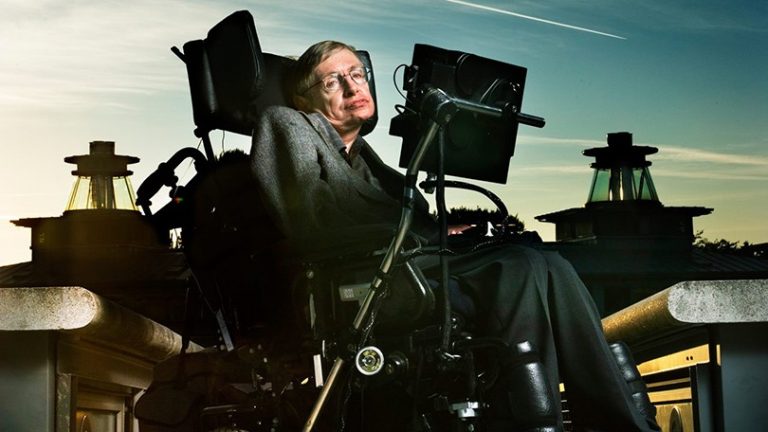
In the photograph Hawking, wearing glasses and a gray jacket, sits in an armchair with a tall dark back. To the right in front of him are a screen and equipment, with mounts and wires visible. In the background is a sky with thin light streaks, rooftops, and a stone balustrade. This is a portrait of a real scientist; there is no text, no poker table, and no characters from the series here.
In captions, a recognizable face can signify either the real complexity of reasoning or the author's exaggerated confidence. Cosmological words create a large scale, and a household task shrinks it sharply. Sometimes the joke is a person who explains the obvious as a scientific breakthrough; sometimes it is an instruction that is too difficult for a simple action. Hawking's role arises from his public association with fundamental questions, while the new statement is composed by the author of the picture.
Physical scale for a small task
The following captions and events are invented. A person tries to calculate how many cookies are needed before friends arrive and builds a table with the number of cups, the length of the gathering, and the expected eating speed. Hawking's portrait signals an overly serious approach to a tea party. The scientific role serves exaggeration, not a report of a real piece of advice from the scientist.
Another invented example is the instructions for a folding chair, where a simple mechanism is shown with twenty arrows. The caption links the attempt to understand the chair with the structure of the Universe. The humor lies in the mismatch between the complexity of the explanation and the size of the object.
In a third invented sketch, a player calls the space under the sofa a black hole, because all the game pieces disappear there. The portrait accompanies a solemn announcement of the discovered cause of the disappearances. A physics term is transferred to familiar household experience, while the comparison remains openly conventional. Each variant uses the image of intellectual work, but sets up its own small object of investigation.