An archival machine and an internet dialogue
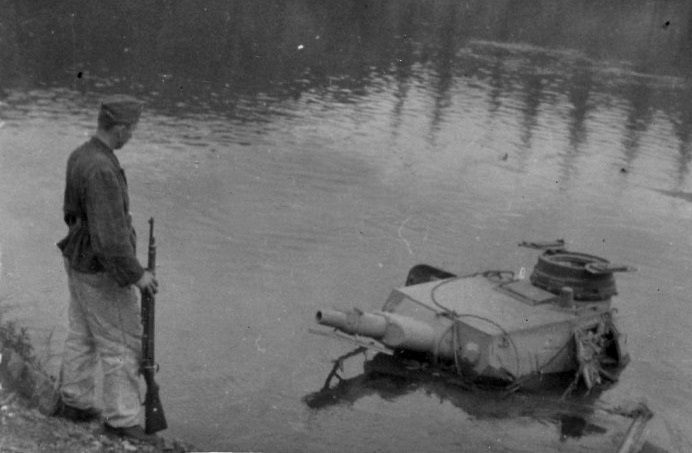
The format is based on an archival photo of a German Panzer IV partly submerged in water. Several historical attributions are attached to the photograph, but the exact date of the shot and the circumstances of the accident cannot be reliably established from the known image alone. For the history of the joke itself, the internet trail matters more: on March 21, 2018, the image appeared on the /k/ board of 4chan, where one reply addressed the machine as a sage of the lake.
A screenshot of that exchange moved to Tumblr, and in the summer of 2018 the format received new captions on Reddit. At the end of July, users of r/Animemes and gaming communities made the tank answer requests for wisdom. This is a sequence of found traces, not proof of the very first dialogue. The meme name “lake” also does not serve as a geographic definition of where the tank historically ended up.
The imaginary sage
On the left, on the bank, stands a soldier with a rifle, looking toward the machine. On the right, the upper part of the hull, the turret, and a short barrel rise out of the water; the surrounding water is calm. Behind the man a strip of shore is visible, and trees are reflected on the surface. The file is black and white, without captions or drawn speech bubbles. The mutual orientation of the man and the tank alone allows one to imagine a conversation, although the photograph does not show it.
The title “The Wise Tank of the Lake” sets up a dialogue between a soldier and an immobile machine. The soldier may ask about love, work, or the meaning of life, and the tank answers with a phrase that is hard to accept. The comedy is built on mismatch: the equipment does not speak, but its stern look turns any caption into an ancient admonition. The more banal the question, the stronger the contrast with the heavy photograph.
Why an immobile tank gives advice
The format's name turns heavy machinery into a fantastic creature living in a body of water. The soldier seems like a visitor who came with a question, and the flooded machine seems like an old inhabitant who has seen too much. At the same time, the tank's position is hard to call favorable in itself: the sage looks stuck. This hidden contrast makes the admonition funnier, because a great authority is given an object in an obviously awkward position.
The answer may be harsh, banal, or completely practical. The military scene gives all three variants a solemn tone; a short everyday phrase removes it. The difference in voices matters: the person formulates a hope for a miracle, and the machine returns them to a condition they wanted to skip. In this way the format simultaneously parodies the fairy-tale meeting with an oracle and the habit of searching for a grand solution to a simple problem.
Three invented admonitions
“O tank, how do you manage to do everything?” — “First stop promising everything.” The question asks for a superpower, and the answer reports an unpleasant limitation. In another variant, the soldier asks how to find the needed item in a backpack and gets “Don't put the whole house in there.” The machine's physical heaviness adds irony to the advice about excess load.
For a game chat, “O tank, why doesn't a rare item make you happy?” — “You've already filled your inventory” would work. Wisdom turns out to be a check of free space, not a philosophy of happiness. All three answers use a compressed punchline after a solemn address: the tank does not lecture, it says exactly what the visitor did not want to hear. The calm water and motionless figure sustain this strange seriousness.