What is visible in the photo
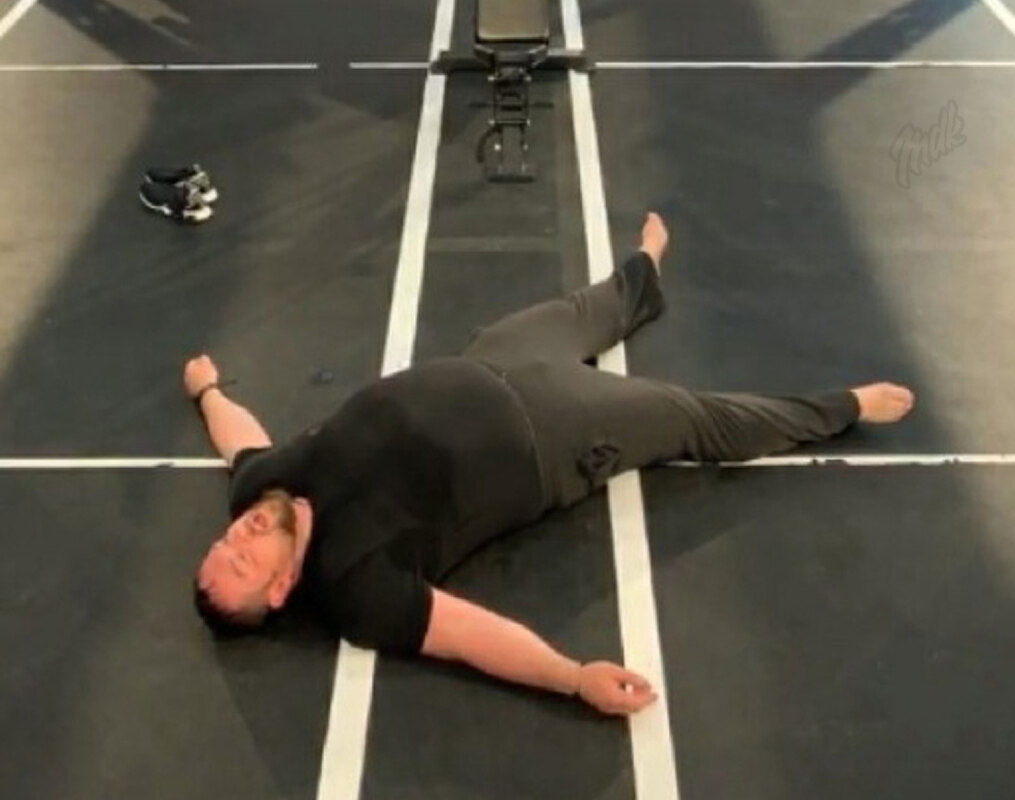
In the frame, a person lies on their back directly on a black sports mat. Arms are spread to the sides, one leg is stretched to the right, and the other is bent at the knee and raised. Behind them is an exercise bench, and in the upper left corner stands a pair of sneakers. Light marking lines divide the floor into lanes; the shot is taken from above, and there is a semi-transparent logo in the upper right corner.
The squats themselves are not shown in the frame. The lying pose indicates a pause or the end of a set, not a result. The picture cannot confirm the number of reps or the date of filming: this information comes from descriptions of the broadcast.
The claim and the broadcast
It all started with an interview with Yuri Dud, which came out on YouTube in spring 2019. Davidych said he could do 1,200 squats without stopping, and the claim quickly became a source of arguments and disbelief.
On July 20, 2019, he held a live broadcast on the smotraTV channel and showed the squats. According to media reports, the broadcast lasted about an hour and a half, and the final tally was 1,251 reps. Roughly after every hundred squats he was brought water. Opinions split: some praised his persistence, while others argued about technique and felt that some reps should not count.
Why captions grew out of the claim
The template rests on the gap between a promise and what was shown. He promised 1,200 and reported 1,251. Formally that is more, but the joke is not in the arithmetic. The loud statement set expectations in advance, and every viewer compared it to what they saw on screen.
So any meme with this pose reads as a comment on a promise and its verification, not as a story about a record. A figure lying on the floor becomes a universal symbol of “I did it, now I can fall down.”
Examples of captions and how they work
Example 1: “Promised 1,200, reported 1,251, and the comments still argue about one extra rep.” It's funny because the argument is over a tiny number, even though the claim was about the whole thing.
Example 2: “Monday plan: half an hour at the gym and an honest admission that half an hour is a metaphor.” A shift in expectation: the plan sounds serious, and the outcome turns out to be self-irony.
Example 3: “When someone in the chat wrote ‘who's up for a run?’ and you've been lying on the mat for half an hour.” The joke depends on an action being announced while the picture shows the opposite.
Example 4: “Said I'd only reply to one email. Three hours later, and here I am.” The pose in the picture serves as the outcome of an unplanned, drawn-out task.
How to use the template carefully
The template suits conversations about claims, promises, and checking numbers. It doesn't suit mocking someone's appearance, health, or fatigue. If a caption turns a hero's exhaustion into a target for ridicule, it stops being about the claim and becomes about humiliation.
It's worth distinguishing the plot of the joke from the biography. The 2019 broadcast is a public event and can be discussed from recordings. Claims about the blogger's other achievements are better left out of captions, since they are hard to verify from open sources.