An advertising character on a dance loop
Dmitry Brekotkin is known from Ural Dumplings (Uralskie Pelmeni) and took part in the Tricolor TV advertisement. The company explained this campaign as a desire to add more showmanship to the presentation of its services. The comedic facial expressions of the presenter were therefore part of the advertising task: a familiar performer had to hold attention and entertain the viewer. Later, one short fragment became convenient material for a completely different performance, no longer about television.
In June 2016 a video titled “Disco [expletive]” by an author known as [username hidden] and bezboltenko appeared on YouTube. Brekotkin's head movement received a musical loop; among the characteristic accompaniments, Tony Igy's Astronomia became established. The format developed alongside RYTP — montage remixes that rebuild original lines and movements. Users changed the music, added color effects and stretched the joke for hours. The new duration became an independent element of the absurd.
A face that already looks like motion
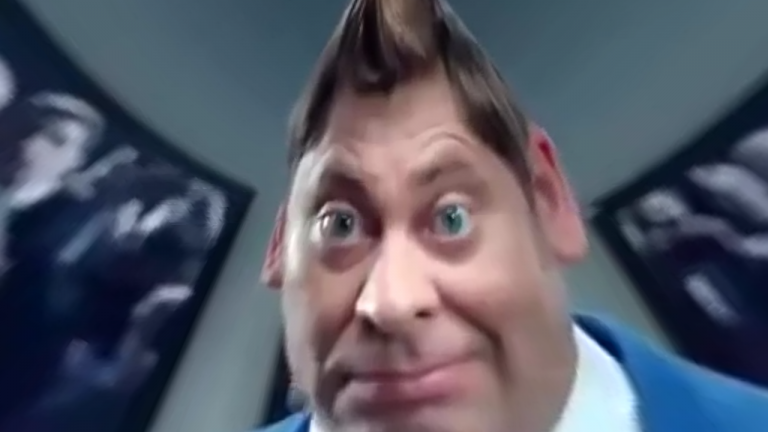
In the picture Brekotkin is shown in a very large close-up. His hair is raised into a tall quiff, his eyes are wide open, and the corners of his mouth create a contented expression. A blue jacket and white collar are visible. The background with screens is blurred; there is no text caption over the frame. The tightness of the shot almost removes the surroundings and leaves the viewer mainly with a face that is easy to remember and then recognize in a new remix.
The still frame itself is motionless, but the slightly unnatural position of the head and the stretched hair recall an intermediate phase of lively movement. For someone who has seen the video, the picture can trigger a mental continuation: the next nod and the familiar musical beat. For a newcomer it primarily conveys funny concentration on their own enjoyment. So this portrait can work as a reaction to a successful rhythm, even though the image contains no sound.
A loop instead of a dance number
In a full dance, the movements usually develop: there is a beginning, a change of pattern and an ending. Disco Face keeps only a small repetition. Because of the precise synchronization, it seems the hero is deliberately performing one perfect nod an infinite number of times. The advertisement stops promoting a service, and the face becomes a kind of musical instrument. The editing controls its rhythm without requiring new action from the original footage.
The long versions amplify exactly the lack of development. First it is funny to see a strange coincidence, then to discover that it is not going to end. Changing the track also changes the meaning: a calm melody makes the expression excessively cheerful, while an energetic one emphasizes the pleasure of repetition. In static use, a caption can name a situation where a person has stopped following the content and simply enjoys the sound. The meme conveys the pleasure of rhythm, sometimes so strong that all other tasks temporarily disappear.
Three invented reasons to keep nodding
The first example: a person sits down to do a foreign-language exercise, but the training recording contains an unusually memorable intro. The caption “Didn't memorize the answers, learned the intro” turns Brekotkin into a student who occupies himself with music instead of the assignment. The nod signals his completely sincere participation, aimed at an unexpected part of the study material.
In a second story, a video game has already loaded, but the player stays in the menu for the sake of the theme. An image captioned “One more round, then I'll start” gives the musical loop a domestic explanation. A third variant: friends try to guess a song from its intro, but the host forgets to stop the favorite fragment. Disco Face shows a person who got carried away by their own question. In all cases the enjoyment is not invented by a separate story: it is already set by the satisfied close-up, and the caption only explains why a small repetition has suddenly become more important than the continuation.