A swing in blurred motion
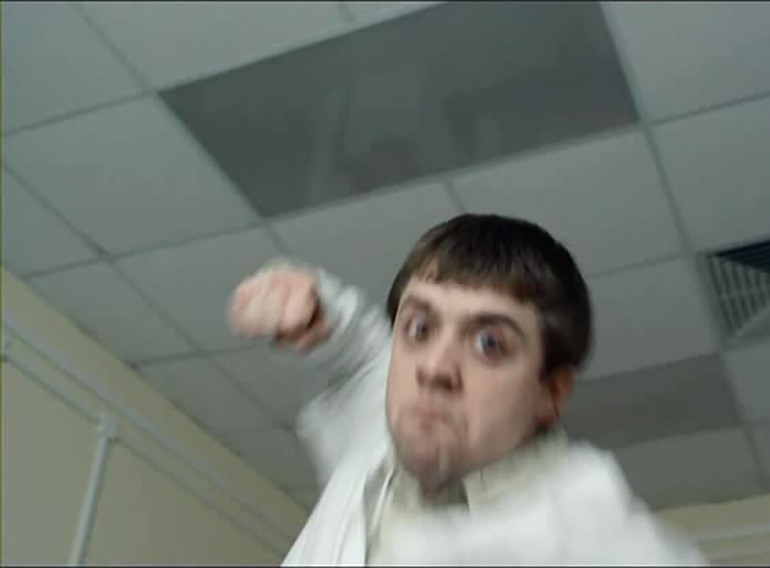
The shot is taken from below, as if the camera is lying on the floor. In the foreground a man with short dark bangs throws a fist toward the viewer, and the arm is smeared by motion, so the blow looks swift. His eyebrows are raised, his eyes wide open, his lips pressed together, and his chin slightly jutted forward. The clothing is light, almost white, with a collar resembling a medical gown.
Above the head are ceiling panels with a square grid; in the upper right corner there is a ventilation opening, and on the left a pale wall with a vertical pipe. Only the face stays sharp, everything else is blurred. This technique makes the frame tense: it seems the blow is about to land.
A good caption is usually short and written so that the reader immediately pictures the offender or the reason. Extra explanations only weaken the tension that the frame itself creates.
Where the image comes from
“Interns” is a Russian comedy series about young doctors, which aired on the TNT channel. The template is linked to the character named Lobanov, and a caption for the picture is usually written as a short line spoken by this character or about him. However, the specific episode and the date when the scene became a template are not reliably established, so it is better to speak only about what is visible in the frame itself.
It is worth distinguishing the character from the actor: the joke refers to the role and its hot-tempered image, not to the person who played it. The surname “Lobanov” is common, so captions involving real people with the same surname from life are neither needed nor appropriate.
Why the swing is funny
The blow itself is not shown in the frame: the viewer sees only the start of the movement. The mind completes the rest, and a caption wins if the aggressive gesture hides something utterly ordinary. This is the same logic as in comedies where a menacing pause ends with a trifle.
The second mechanism is the mismatch of tone. The character’s face looks more surprised and slightly frightened than angry, and this contrast with the gesture creates the comic effect. The first part of the caption sets up the tension, the second explains that the cause was a trifle.
Caption examples
“When someone in the group chat asked who ate my yogurt.” A petty everyday loss swells into the scale of a brawl, and this immediately reads as exaggeration.
“A colleague wrote ‘let’s skip the discussion’ on Friday at five in the evening.” The gesture reads as a reaction to an almost harmless work matter, and the gap between the cause and the reaction powers the laugh.
“Waiting for the provider’s support to reply for the third hour already.” The template conveys accumulated impatience without a single extra word.
In all the examples the pattern is the same: a short everyday cause and a frame that promises serious consequences. The joke works best when the cause turns out to be extremely small and the gesture is left unfinished.
Where the template fits
The frame suits self-irony and everyday situations: a queue, waiting, small office irritations. It works best when the caption is written in the first person and the hero jokes about his own hot temper.
Do not use it against real people, especially those recognizable by face or personal story: then the swing stops being a joke and becomes a display of aggression. The template is not meant for calls to violence or threats.