The Rock’s portrait and the meme edit
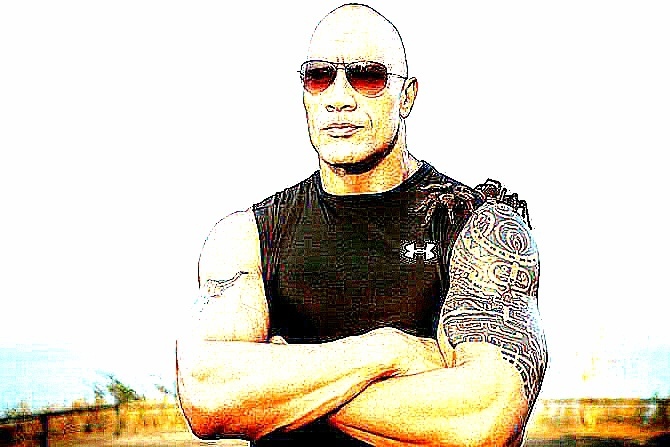
The basis of the family is a photo of Dwayne Johnson with his arms folded. The actor and wrestler, known as The Rock, is pictured in a black athletic tank top and sunglasses; a large tattoo covers his shoulder and arm. Early reviews link the original promotional portrait to 2013. The photographer and the specific advertising campaign have not been established in the available history of the meme.
Miroslav Bratishkin, the author of the remix, said he created it at the end of 2017, inspired by a similar image of Bruce Willis. He lowered the image quality and changed the proportions of the portrait, then added a crude caption. According to him, the picture first appeared in comments and only after several months began to circulate in other communities. This is an account of how the variant was made; the notable Russian-language wave dates to July 2018.
What is missing without the red letters
In the picture, Johnson stands in an open space, with no other people visible in front of him. His folded arms take up almost the entire width of his body, and the sunglasses hide his gaze. The contrast is pushed so far that the skin and the light background lose detail in places. This is a processed version of the portrait, but the famous red inscription is not on it. The title describes the format this image belongs to, not the literal text of this file.
A pose like this usually promises strength, confidence and superiority. Here, the harsh processing makes it even more demonstrative and at the same time strange. The hero seems to be presenting his own image far too seriously. On such a base, a single unexpected line is enough to turn advertising-level confidence into a parodic self-presentation. The folded arms themselves do not express failure; the comic effect comes from their combination with the caption.
The confession sounds like an achievement
The oddity of the title lies in the reversal of the expected statement. From a person in such a confident pose, one expects an announcement of victory, strength or experience. Instead, he solemnly reports his own absurdity. The result is a form of anti-bragging: the admission of a mistake is delivered with the dignity that people usually display.
This mechanism makes the picture usable for self-irony. The author describes an invented act of their own, and the image of The Rock serves as a mask. The specific mistake helps explain why such a confident pose was needed: the hero did not simply err, but stayed certain of his decision to the very end. A single word after the colon or a short caption can keep the crude original tone, although the construction also allows a softer wording.
Three invented proud failures
An invented example: “Bought a new calendar so I’d stop mixing up the dates. Bought last year’s.” The self-confidence is tied to a useful goal, which the act itself immediately destroys. A second variant: “Spent ages choosing a silent alarm clock and was surprised I didn’t wake up.” Here the hero seems proud of a decision that contradicts the purpose of the object, so the stern pose amplifies the absurdity.
A third storyline: “Deleted all my notes to tidy up my to-do list.” Clearing away the outward mess destroys the information that was needed. Each case is invented, and each frames the mistake as a confidently completed project. On the picture without letters, one can place a neutral “I planned everything”: the viewer will see the same gap between the declared competence and the described result. The uneven quality of the portrait supports the deliberately absurd solemnity.