A roar in front of a waterfall
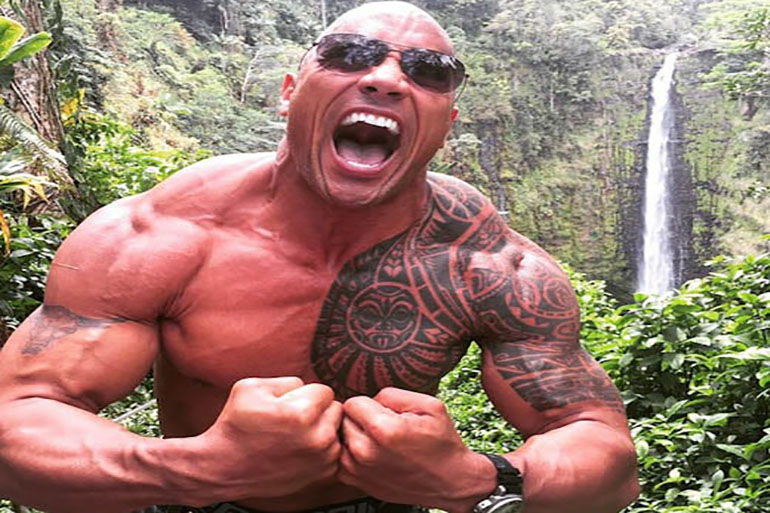
The photo shows a man in dark sunglasses with a clean-shaven head and a muscular torso. He opens his mouth wide, as if shouting, clenches his fists at his chest, and tenses his muscles. A large dark tattoo design is visible on his chest and shoulder. Behind him are dense greenery and a tall waterfall, and a tropical plant leaf stretches along the side.
The man is commonly called Dwayne “The Rock” Johnson. The frame looks like a personal photo from a tropical trip, but there are no reliable open-source details about the place or date of the shoot, so they are not named here.
Where the caption came from
The photograph itself is a striking shot of a man flexing. It became a meme thanks to a crude Russian-language caption, which read the hero’s physical effort as jubilation over a completely mundane occasion. Who first combined the photo with this caption could not be established; the spread is dated to 2021.
It is important to distinguish: the photo is one thing, the joke is another. Johnson is only the face of the picture in the joke. The caption says nothing real about him and tells nothing about his life.
Why the mismatch of scale is funny
The mechanism is simple: a loud, almost heroic gesture gets a laughably small cause. The waterfall and bulging muscles create an epic backdrop, while the caption reduces everything to the simplest physical pleasure. The more serious the pose and the smaller the reason, the stronger the effect.
The second detail is the Russian intensifier “zhestko” (roughly “hard” or “seriously”). In everyday speech it carries a shade of “for real, no joking”, and its pairing with an everyday occasion heightens the comedy: an achievement is presented as a feat.
What is actually visible in the frame
A few details hold the effect together. The sunglasses hide the eyes, so all the emotion is concentrated in the mouth and the tense arms: the face has become one continuous shout. Fists clenched at the chest strengthen the impression that the man is not just posing but pushing the sound out with all his strength.
The frame is cropped close, and there is nothing in it but the hero and nature. That is why the caption fills the emptiness: the viewer sees only the pose and the greenery and waits for an explanation. Any text that explains the cause of the shout gets automatic force, and that is why the template is so easy to remake.
Sample captions
“Closed all the tasks in the task tracker before lunch.” The gesture stayed the same, the occasion became work-related, and the contrast between frame and action works just as in the original.
“Found a parking spot right by the entrance at seven in the evening.” Here an everyday win, understood by every city resident, becomes a triumph.
“The cat walked into the carrier by itself.” The jubilation fits because the event is rare and needs luck, not muscles.
“Me when I sent an email and didn’t forget the attachment.” A small but important bit of luck is presented as a large achievement.
How to use the template
The photo works best when the caption describes a small win. Captions that put the hero in an embarrassing light are duller and unnecessary: what makes people laugh is the joy itself. Do not put claims about the real actor into the caption: this is just a template with a strong pose.
How the template mutates
The original crude caption was gradually pushed out. Users kept the pose and changed the occasion, from minor wins to absurd feats. This produced a parody line: the caption keeps the structure “loud declaration plus a small event”, but the vocabulary differs each time, down to completely clean versions for family chats.
This is convenient: the template is not tied to a single word and outlasts the vogue for particular expressions.