Composition of the caricature
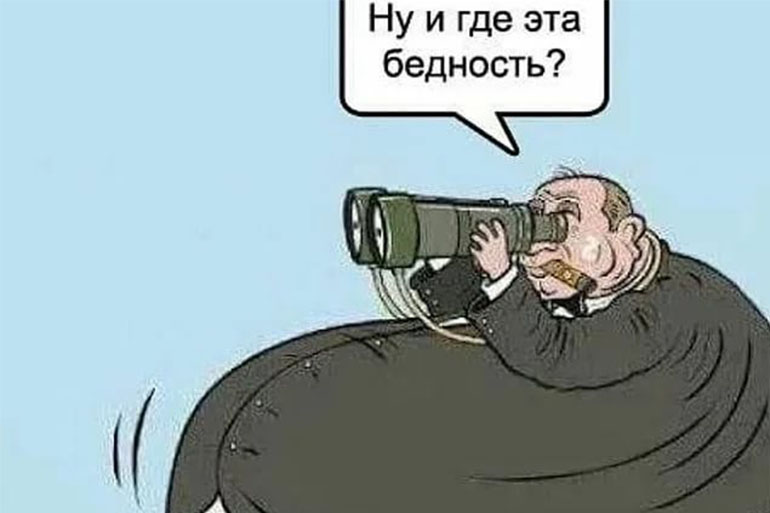
A cartoon man with a large belly looks through a spyglass; next to him below, a small person is addressing him. The caption "So where is this poverty?" relies on visual blindness: the observer looks for poverty without noticing the person right in front of him. This is a graphic caricature, not a real photograph of a specific politician. Details differ between copies of the template, but the contrast between the wealthy observer and the person in need remains the basis of the joke.
From caricature to political meme
In early March 2022, a meme spread in Russian-language social media in which a large character does not notice a "small" one and asks where the poverty is. In variants, the characters were changed and captions about inequality, wealth and everyday hardship were added. The original drawing was satire and then became a portable template. The exact author of the first version and the chronology of individual copies are not fully confirmed; the image should not be attributed to a well-known artist without verification.
The mechanics of invisible inequality
The question sounds like sincere bewilderment, but the viewer sees the reason: the man is looking in the wrong place, or is too sheltered by his position to notice others' need. This visual contrast helps discuss social inequality and privilege. In a lighter version it can mock everyday incomprehension: someone who works from home is surprised that others take a long time to reach the office. But when real poverty is discussed, a caricature does not replace data and personal testimony.
New variants
"So where is this lack of time?" asks a person who has no children and works four hours a day. "Where is the queue?" says someone who came in through the staff entrance. "So where is the exhaustion?" writes a manager who has never seen the team's night shift. These variants develop the theme of inattention to other people's conditions. Do not use the image to ridicule people who have ended up in poverty: the target should be the observer's blindness, not the person who is suffering.
Not oversimplifying real problems
The meme caricature deliberately exaggerates social roles and does not describe specific statistics. Poverty is measured by different indicators, such as income and access to housing, healthcare and other basic resources, and it does not disappear because it is hard to see from a privileged environment. If a publication relies on real figures, state the period and methodology separately. The picture may play on inequality, but it does not prove its scale and does not identify the man as a public figure.
Different versions could replace the vulnerable character with a child, a worker or a generic passer-by. Such variants carry different emotional weight and require considering whom the image presents as the object of mockery. The most accurate reading is a critique of a person who, from a protected position, refuses to notice need. When transferred to a work chat, poverty can be replaced by a workload invisible to the manager, keeping the joke aimed upward, at the one who does not notice the problem. This keeps the satire clear without humiliating a person who is asking for help.
In some copies the main character is huge while the figure next to him almost disappears; the scale reinforces the idea of a limited field of view.
The viewer therefore reads the picture as satire on a limited field of view, not as evidence about real people.