A question in the middle of the struggle for Wakanda
The source is the Marvel film “Black Panther,” directed by Ryan Coogler and released in 2018. Michael B. Jordan plays Erik Killmonger, who challenges T'Challa, the hero played by Chadwick Boseman, and demands the throne of Wakanda. The rivals meet in a ritual duel at a waterfall. It is here that a personal clash becomes a dispute over who the people around them will recognize as having the right to rule the country.
The famous question sounds after Killmonger has defeated his opponent, while T'Challa is still standing before him. Then he throws the fallen rival off the waterfall. Thus, this is a display of another's defeat during the fight, not a shout before it begins. Killmonger addresses the witnesses: he wants to destroy their image of the former ruler by showing that he turned out to be vulnerable.
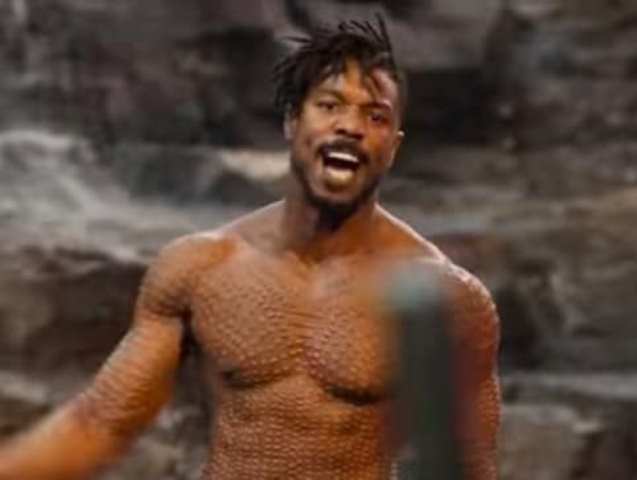
A frame without the king and without the shirt
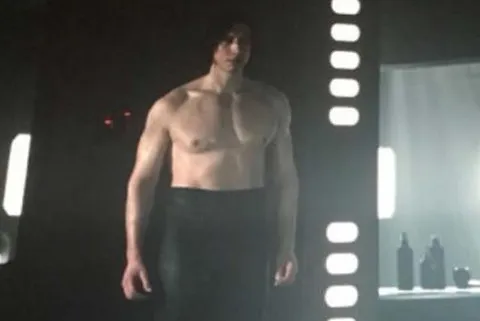
The image shows only Killmonger with a bare torso. He looks ahead, mouth wide open; his arm goes out past the left edge. Numerous markings that make up the character's look are visible on his skin. Behind him are gray rocks. Neither T'Challa himself, nor the duel's spectators, nor a caption with the question appears in this frame. But the close-up keeps the force of the address: the hero is clearly not speaking quietly to a single close interlocutor.
The absence of a second participant makes the reaction easy to carry over. The viewer can substitute in its place a thing or a person that the caption is already discussing. The open mouth and the outstretched pose add an accusatory intonation even for those who don't remember the line word for word. The markings on the body relate to Killmonger's makeup and the film's story; the comedy of new scenes does not require inventing a personal biography for the actor based on this image.
From a movie shout to checking loud promises
In March 2018, the frame spread widely on Twitter along with remakes of the question “Is this your king?” Early examples changed the object of outrage: instead of a ruler, a season, money, or an everyday result would appear. Available March posts record this wave but do not allow naming one person as the inventor of all the variants. The text construction itself suggests its continuation: it is enough to replace the last word.
The question is structured as a challenge to the supporters of whatever disappointed. The speaker doesn't simply state “I didn't like it” but demands an explanation: why did you praise this? That's why the caption often includes a prior reputation: a champion, the best route, a flawless recipe. The picture appears at the moment a funny mismatch is revealed. The smaller the everyday failure, the more noticeable the theatrical exaggeration: a trifle is presented to the public as an argument against an entire reign.
Three invented contenders for the throne
“The training bot after beating the champion of our game night: ‘Is this your king?’” The line goes to the most modest opponent. Yesterday's favorite loses its grandeur before a creature built for warm-ups, and the witnesses are friends who had just presented him as unbeatable.
“The closed gate at the end of the ‘shortest route’: ‘Is this your navigator?’” Here Killmonger plays an unexpected obstacle. The road could indeed have been short, but it didn't lead to the promised result. The question tests the practical value of a loud advantage rather than arguing about every turn.
“Burnt cottage cheese pancakes after a story about a secret family recipe: ‘Is this your chef?’” Authority is built up by the cook's long introduction, then refuted by a visible breakfast. The stern intonation of the film makes the kitchen disappointment comically grand: as if the fate of a throne were being decided over an ordinary plate.