What is visible in the photo
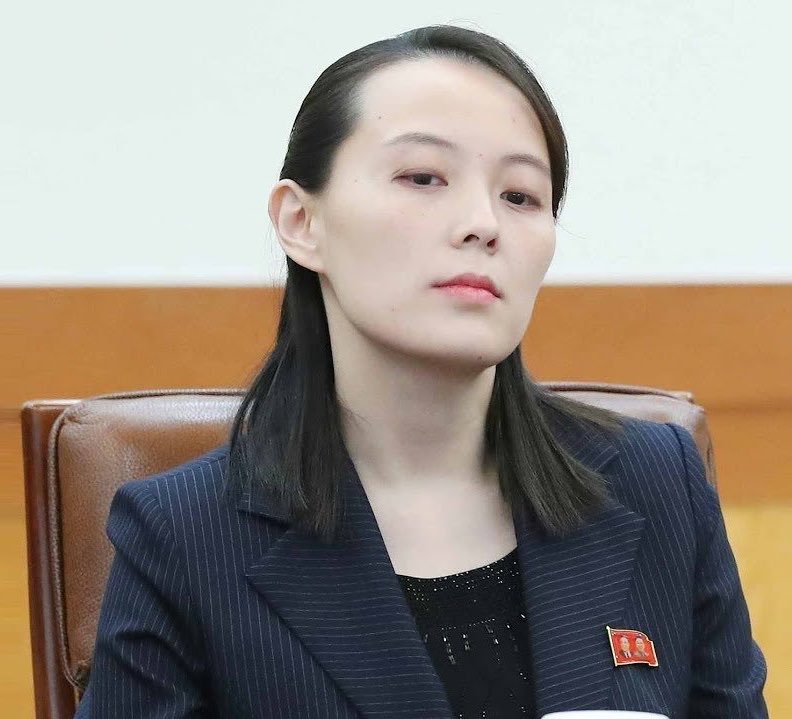
The portrait is a close-up of a woman with dark straight hair to the shoulders. She wears a dark blue jacket with a thin light stripe and a black glossy top underneath. On the lapel is pinned a red badge with two small portraits, the kind customarily worn on the chest in North Korea. She sits in a leather armchair against a light wall and wooden paneling.
The facial expression is the main thing in the frame: the eyes are half-closed, the gaze turns aside, the lips are pressed together. Some see contempt in this, others fatigue or boredom. What she actually felt cannot be told from the photo: it is just a moment caught by the camera, and it is precisely this ambiguity that makes the frame convenient for captions.
Who she is and what she is known for
According to South Korean sources, Kim Yo Jong was born in 1987; US official documents give 1989, so the date remains a matter of discrepancy. In November 2014 she became first deputy head of the Propaganda and Agitation Department of the Workers' Party of Korea, and in October 2017 she entered the Politburo as a candidate member.
She became widely talked about in February 2018. She came to the opening of the Winter Olympics in Pyeongchang as a special envoy of her brother, delivered a personal letter to South Korean President Moon Jae-in, and became the first representative of the Kim family to visit the south of the country since the Korean War. Photographs from those meetings reached the world's media, and the leader's sister's reserved expressions were discussed online on a par with politics.
Spring 2020 and the surge of interest
In April 2020, media reports appeared that something was wrong with Kim Jong Un's health. The data were contradictory and not confirmed; in early May, North Korea's state media showed the leader in public. While speculation continued, analysts and journalists discussed who might take his place, and his sister's name came up in these conversations as one of the possibilities.
It is important to separate the joke's premise from the biography: whatever commentators wrote, the reports about succession of power were guesses. Memes claim nothing about her real plans; they draw on a recognizable face and the aura of a closed country about which the public knows little.
How the image lives in jokes
The snapshot works as a “silent disapproval” reaction. While an ordinary person answers in words, this portrait answers with a pause: a serious political figure looks as if she has just heard something absurd. The smaller the occasion, the stronger the contrast between the grandeur of the image and the situation.
A second line of jokes is built on the fact that we know almost nothing about her opinions, so they can be “invented” for her: she approves, doubts, waits for explanations. This device does not require knowledge of politics and suits any everyday plot.
Examples of captions
“When in the work chat someone asked who would make the presentation, and everyone unanimously went quiet.” The caption turns the frame into an assessment of the situation: the look says what nobody will say aloud.
“Me when my friend says for the third time that he'll start a new life from Monday.” It works on repetition: the joke builds from past promises, and the face in the photo expresses accumulated fatigue.
“Courier: the order will arrive in fifteen minutes. Two hours have passed.” The contrast between waiting and the result emphasizes the cold look.
Less successful are captions that attribute specific actions or decisions of real politics to the heroine: such jokes turn a guess into a “fact” and quickly lose their humor.
How to use the frame
The portrait is best suited to short everyday captions without politics: skepticism, waiting, quiet disapproval. It is expressive on its own, so long explanations only get in the way.
Do not attribute to the heroine statements, illnesses or plans: the caption should describe your own mood, not an invented position of a real person.