What can be seen in the picture
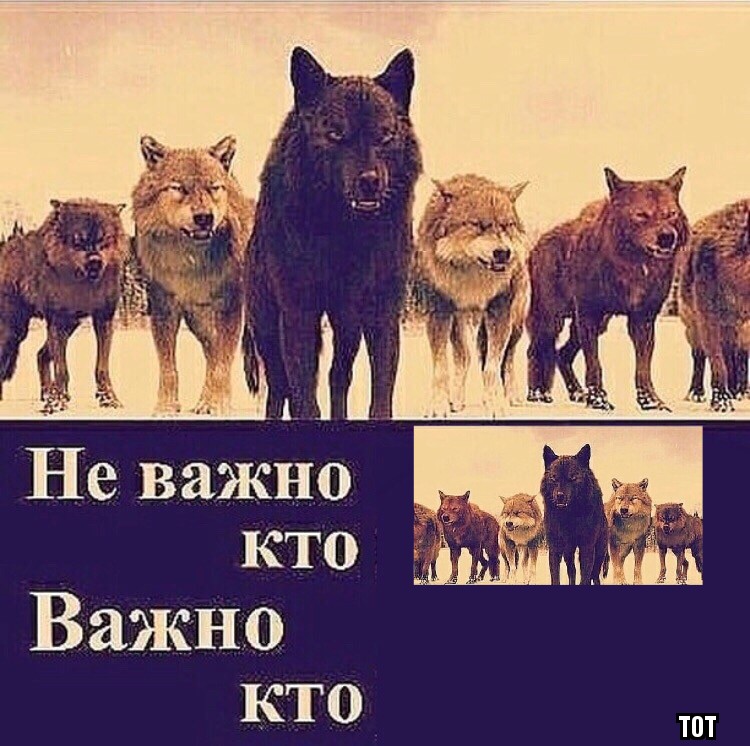
The upper part is a wide shot of a pack of seven wolves standing in a row on a light snowy background. The colors are warm, sepia-toned, and the image looks processed. At the center stands the largest dark wolf, looking straight ahead. The other wolves, in reddish and gray shades, stand to the left and right, and some have bared muzzles.
The lower part is a dark purple panel with large light words, “Doesn't matter who” and “Who matters,” split into lines in different fonts, and a small copy of the same frame on the right. In the corner is a small logo of the repost page. This composition is typical of pictures with “wise” captions that spread across social networks.
What is known about the origin
The origin of the frame and the caption is not established. It is unknown who assembled the picture and when, and the author of the original photo could not be reliably confirmed. From its appearance alone one cannot say with confidence whether this is a real photograph or a processed image: the wolves stand in a very even row, and the colors are heavily muted.
Stories in retellings about a specific photographer, a nature reserve or a “female leader” relate to other photos of wolf packs and are not tied to this picture. So it is only appropriate to speak of what is visible: a pack lined up before the camera and a large wolf in the center.
How the caption is built
The caption is built on a rearrangement: the familiar formula “it's not what, it's who” becomes “it's not who, it's who.” The second line answers the first, and the blank in the formula is filled by the author of the caption. The reader first registers the pompous tone, then notices that the meaning remains open.
It sounds like a condescending “doesn't matter” followed by a confident conclusion. Combined with the large dark wolf in the center, the picture becomes a joke about leadership that rests on outward confidence rather than on words.
Examples of captions and their explanation
Example 1: “It doesn't matter who wrote the report / What matters is who signed it.” The rearrangement shifts attention from the work to the formality, and the frame adds confidence.
Example 2: “It doesn't matter who was late / What matters is who brought the cake.” Funny because what is important in one line turns out to be a trifle in the other.
Example 3: “It doesn't matter who's in charge of the group / What matters is who types ‘ok’ first.” The caption lowers the leader's status to an everyday role, while the wolf in the center still looks solemn.
Example 4: “It doesn't matter who's to blame / What matters is who will do the dishes.” The second line changes the meaning of the whole phrase: a talk about guilt becomes a talk about routine.
In all the examples, the second line sets a new criterion of importance. If both lines sound equally weighty, the joke disappears, so the contrast must be explicit.
How to use the template
The template suits topics about collective work, family conversations and the division of duties. It is better not to tie the caption to a specific person from a chat or to a colleague: keep the joke about the situation, not about a person.
A short two-line caption modeled on the original works well. If there is too much text, the viewer stops seeing the composition: the central wolf and the lineup of the pack should remain the main thing, while the caption only sets the tone.