From an accusation to other people's costumes
In late April 2018, photographs of Keziah Daum from Utah sparked a dispute on Twitter. For her prom she wore a qipao, a Chinese dress. The user Jeremy Lam wrote the accusatory phrase that became the meme's title. Some participants in the discussion talked about cultural appropriation, while others defended the girl's choice. Daum herself explained it as respect for a beautiful culture, not as an intention to offend anyone.
The h3h3Productions channel and Ethan Klein took part in the reaction to the dispute, carrying the strict formula over to ever more unexpected objects. Then it began to be combined with costumes depicting food, hobbies, or fictional characters. By early May such parodies already made up a separate wave. The serious statement retained its personal “my” and its address to someone else's outfit, but the word “culture” could now refer to a very small group united by a single taste or habit.
Soda turns into a ball gown
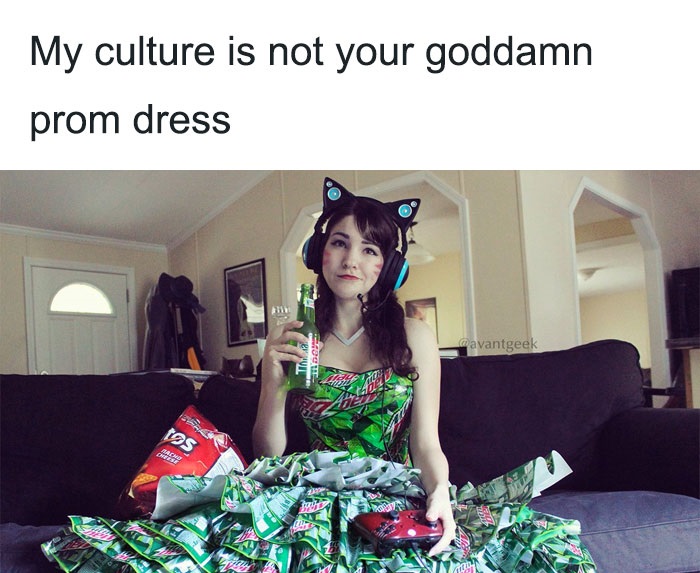
In the picture, a woman sits on a dark couch in a green outfit with numerous packages of Mountain Dew. In one hand she holds a bottle of this drink, and with the other she touches a red game controller. Nearby lies a red bag of Doritos. On her head are headphones with decorative ears; the photo keeps the credit @avantgeek. Above the image is an English phrase about culture and a prom dress.
This is a separate costume photo used for the parody, not a shot of Keziah from that prom. The exact first post of this remix has not been established. The game item, the chips, and the soda form a recognizable set of hobbies, while the lavish outfit makes it deliberately festive. Everyday packaging receives the form of clothing for a solemn appearance. The contrast is especially noticeable against an ordinary room: the couch remains domestic, but all the attention goes to the enormous green costume.
A claim to one's own small culture
The template changes the scale of the original claim. A statement addressed to a traditional national dress now sounds on behalf of fans of a specific product or pastime. The author of the parody imagines that they too have carefully guarded symbols, and that someone else's dress has unexpectedly intruded on their territory. What is funny is the disproportion: a habit of drinking soda becomes the basis for a solemn declaration about cultural boundaries.
At the same time, the picture can joke not only at the accuser. The unusual costume itself turns a taste into a visible affiliation, as if love for a drink had to be proven across the entire area of a skirt. The bottle and the bag of chips repeat the motif of the clothing, leaving no doubt about the chosen theme. The meme combines two hyperboles: an excessively expressive hobby and an equally expressive attempt to call it one's own exclusive culture. The imaginary community is united by attachment to a drink, and its symbols are the bottle and the packages.
Whose outfit it could be
In an invented remix, a board game collector is outraged by a dress covered with a dice pattern: “My culture is not your evening gown.” An everyday hobby item gains the status of a ceremonial emblem. Another example shows an imaginary sweater with dozens of open browser tabs. A person who has for years been putting off reading them claims rights to this pattern, as if the clothing had appropriated his particular way of life.
A third invented storyline concerns a home baking enthusiast: the festive outfit depicts measuring spoons, and the hero is indignant that his culture has turned into decoration. Here the original dispute is carried over into the sphere of hobbies while keeping the structure of an appropriated symbol. The outfit must be concrete enough for the viewer to recognize the pastime, and the speaker must be serious enough for a small habit to suddenly acquire enormous significance.