In the film the glasses are already a nuisance
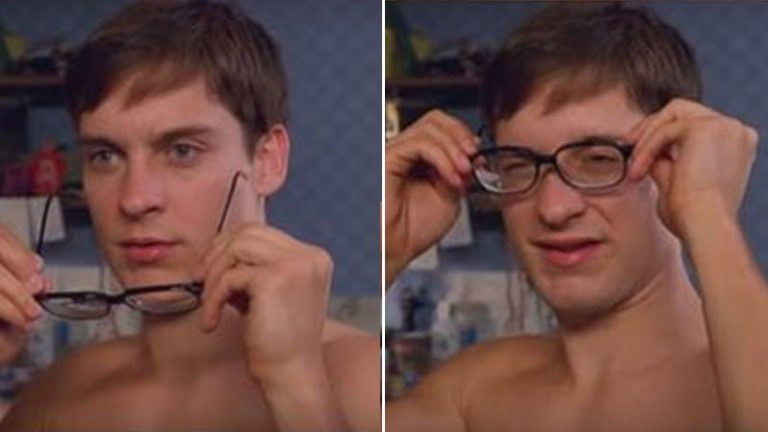
The scene is taken from Sam Raimi’s 2002 Spider-Man. After the spider bite, Peter Parker discovers changes in his body; among them, improved eyesight. His old glasses no longer help: through them the picture blurs, while without them the hero sees clearly. This detail is also present in David Koepp’s script. The movement with the glasses becomes one of the everyday tests of new abilities, long before a full superhero costume.
The wide spread of the comparative meme format dates to 2016, when collages with these frames circulated on 9GAG and Reddit. In remakes, Parker’s vision often works by a familiar everyday pattern: he puts on glasses and at last sees the true essence of the object. Thus an edit can change the film’s original optical logic. This does not stop the joke from being recognizable, since the gesture with the frames already signals the transition between two ways of looking.
Two adjacent portraits
This version places two frames side by side. On the left Parker is without glasses, holding the frame below his face; on the right the glasses are already on, and the hero squints and changes his expression. His bare shoulders and a domestic background are visible. The shots have close framing, so the small object on the face becomes the main visible difference. There are no pictures in the scene that he is supposedly examining.
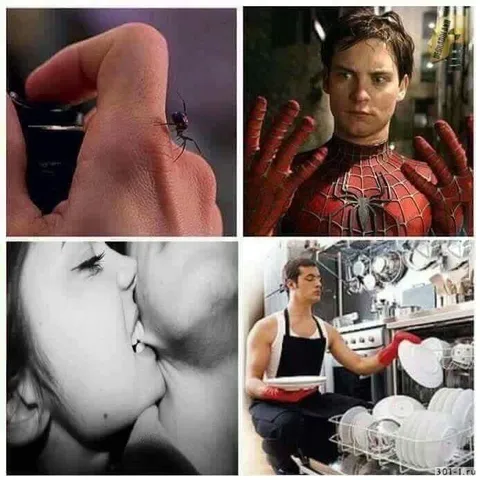
A popular four-panel collage supplements these portraits with a pair of comparison objects. The viewer then first sees a reaction and an object, and then a new reaction and its replacement. The two source frames by themselves leave the cause of the change open. They can be read left to right as putting on glasses, but the position of the frames alone cannot determine which assessment will count as correct: that is set by the neighboring images and captions of the particular remake.
Vision turns into judgment
The meme replaces a physiological change with an intellectual one. Parker seems to notice a resemblance, spot a hidden detail, or revise his first impression. The face links two pictures into a small story, although the objects themselves may have no event-based connection. Instead of a dry comparison, there appears a person who needed a second to understand what he saw. The glasses mark this additional look.
Comparison can be visual or semantic. Similar silhouettes allow one thing to be mistaken for another, while a caption about a discount and a picture of a full receipt turn the change of vision into an assessment of a promise. The second object is often cruder and simpler than the first, so it reads as a sarcastic translation of a pretty shell. The direction can also be reversed, though: a new look can reveal a pleasant resemblance or restore an object’s appeal. The format conveys a change of perception, not necessarily an exposure of deception.
Invented results of a second look
The first example compares a folding chair with a familiar robot: Parker looks at ordinary furniture, then discerns a similar silhouette in its legs and backrest. Additional pictures explain the discovery, and the hero’s face makes it a moment of recognition. Nobody exposes anything here — the joke rests on an unexpected outward resemblance.
In another variant, the words “quick registration” are replaced by a long list of required fields. The glasses become a symbol of getting acquainted with the details of a promise. The third invented example shows a neat stack of books that, on a second look, turns into a set of props for a wobbly table. The change of assessment reveals the practical purpose of the objects. In every case the second image gives concrete new information, so the viewer understands why Parker changes his way of looking at all.