The Eric Andre sketch
The source is The Eric Andre Show, an Adult Swim comedy show hosted by Eric Andre and his co-host Hannibal Buress. In the sixth episode of the second season, which aired on November 7, 2013, Andre interrupts a monologue, shoots Buress, reloads the gun, and carries on. Afterward he turns to the camera and asks who killed Hannibal. It is staged absurdity: the viewer has just been shown the answer, and the host plays at complete ignorance.
The clip spread online before the big wave of images; its posts from 2016 are known. In April 2018 the footage became especially popular as a caption template for characters, including on Reddit in r/dankmemes and r/MemeEconomy. Video and macros therefore went through different stages of distribution. The TV air date does not mean that the modern way of captioning this scene appeared at the same time as the broadcast.
The moment after the act
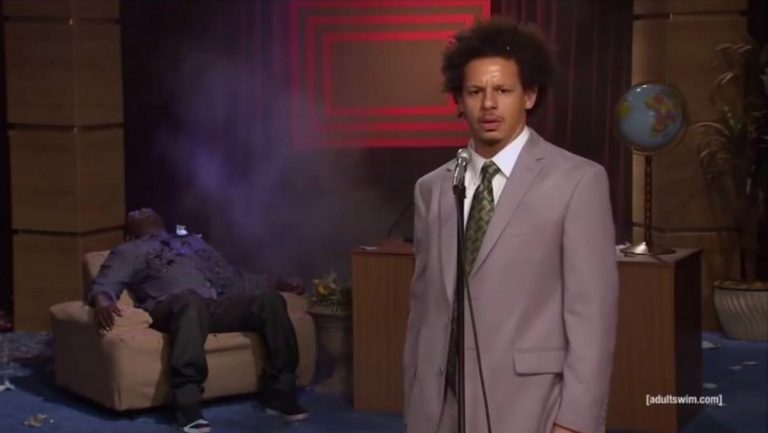
This image contains a single frame rather than the usual “before and after” pair. Andre stands in front at a microphone in a light suit and green tie, looking toward the camera with a puzzled expression. On the left, Buress is leaning back in a chair with smoke visible around him. Behind them is a studio set with red lines, and a globe on the right. No gun is visible here. The connection to the earlier shooting comes from the recognizable sketch or an explanatory caption, not from a weapon in the frame itself.
The cause pretends to be an observer
In the full two-panel version, the first part shows the act and the second part asks about its consequences. The caption on Andre marks the one who acts; the caption on Buress marks the injured object, a habit, a project, or a social phenomenon. The final line tries to push the cause beyond the picture. The viewer enjoys the obvious mismatch between what happened and how the culprit describes it.
It can be read as a deliberate excuse or as genuine self-deception. In the first case the character knows he is responsible and looks for a convenient outside figure to blame. In the second he sincerely fails to connect the action with its result. The image fits both readings, because Andre's surprise contains no explanation of his motives. In a single frame, the caption has to restore the missing causal chain; without it, what remains is just a bewildered host beside the results of a strange little sketch.
Where the free space went
In a fictional example, a character downloads three huge games every day without deleting the old ones. Andre is captioned “me,” and Buress is captioned “disk space.” The final question: “Why does my computer keep asking me to delete something?” The joke rests on turning file accumulation into a mysterious external threat.
A second fictional sketch: a book club organizer cancels the discussion every week for urgent matters. At the next meeting he complains: “Why does nobody ever finish reading by the scheduled date?” Buress's place is taken by the members' habit of preparing, and the surprised host is the person who gradually made preparation pointless.
A third fictional story moves the format into a game. A player sells all healing items to buy a nice cloak, then is surprised by how hard the next fight is. The line “Why is this boss so unfair?” ends the small chain of decisions. The meme assigns a dramatic defeat a simple cause that the character preferred to forget.