What the frame shows
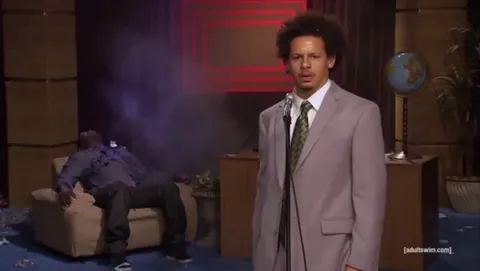
The photo shows two young men standing on an open area by a road. In the distance a house is visible; on the right, grass and trees, and at the right edge a bench. The man on the left, in a black T-shirt, turned sideways, points his finger toward his interlocutor or the camera. On the right, in a light baseball jersey with dark trim over a gray T-shirt, stands the second. He looks straight into the lens with a serious, slightly puzzled expression.
No one is disappearing in this frame yet: it is more the start of a scene. The fading effect can be seen in neighboring frames of the series, while here we see only an ordinary street shoot, which makes the subsequent trick seem even more unexpected.
Where the template came from
According to overviews of internet culture, the disappearing character was invented by a comedian performing under the name Nileseyy Niles. On April 28, 2015, he released three short videos on the Vine service. In each, he ended up in a tense or disputed situation, flashed a peace sign with two fingers, and “disappeared” using special effects.
Mass spread began on June 19, 2015, when a Twitter user posted screenshots from the third clip with a caption about how to avoid a fight. The tweet gathered thousands of likes and reposts, after which the frames came to be used as a universal reaction. Exactly which frame this is and which clip it was taken from is not known for certain, so this shot cannot be confidently attributed to a specific episode.
The meaning of the gesture
The peace sign in the joke reads two ways: it is both a polite “bye” and a defiant “I'm out, sort it out yourselves.” The disappearance adds a magical solution: the hero does not have to invent excuses, it is enough to dissolve beautifully. That is why the frames are seen as an ideal way to leave a situation that has become too uncomfortable.
The caption usually describes such a situation in its first part, and the frame works as the punchline. While the caption is being read, the viewer already expects to see how the hero vanishes.
It is important that disappearing in these jokes is not perceived as defeat: the hero leaves smoothly and with humor, leaving the others to deal with the consequences.
Caption examples
“When someone in the work chat asks who is ready to take on one more task.” The joke works through the instant disappearance of responsibility.
“Me, when the family group chat turns to politics.” The peace sign here means “I have nothing to do with this.”
“When guests say: let's take turns washing the dishes.” The disappearance reinforces the irony: everyone understands how such a request ends.
“Me, hearing the words ‘call on Saturday’” — a palm rises in a peace sign, and the phrase breaks off exactly where excuses usually begin.
Why the template lives on
The idea of escaping a problem is understood in any language, and the movement itself is light and friendly. The template is not tied to a film, a celebrity, or a plot, which allows it to be inserted into any story. All that is needed is a bit of irony and a willingness to laugh at one's own reluctance to take part.
When using it, it is worth remembering that the frames show real people who are not obliged to become objects of mockery. The template works best as a joke about the narrator himself or about a general everyday situation.