“Night Light” and the repainted book
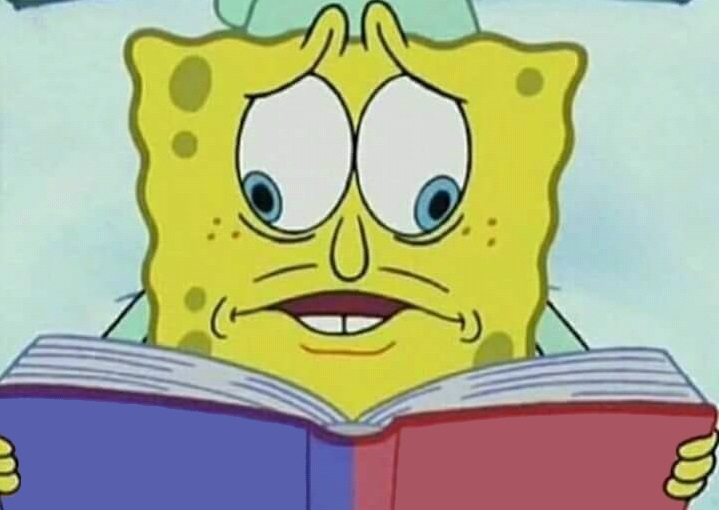
The scene occurs at the start of the episode “Night Light” from season five of SpongeBob SquarePants, which aired in 2007. SpongeBob reads a frightening book and afterward becomes afraid of the dark. For a second, each of his eyes turns toward its own page. This brief cartoon gesture later detached from the plot and became an image of trying to perceive two different things at once.
In the meme version, one half of the cover is repainted blue, and the other stays red. The image shows yellow fingers along the edges of the open book, pupils lowered toward the pages, and a stretched mouth. This is already a prepared color template, not an unchanged still: the contrast helps label the sides and link them to different activities. No literal text from the book can be made out in the frame.
Two pages instead of one decision
The template’s mechanics are simple: the left page gets one option, the right another, and the face shows the impossibility of choosing or holding both in mind. The captions can mark two projects, two games, two notifications, or a conflict between plan and reality. It matters to place comparable objects on the sides, otherwise the gaze loses meaning. The comic effect strengthens if both options are attractive or both demand urgent attention.
The first known remakes
One of the early traceable instances of the format is a post by scottbeckman on r/BikiniBottomTwitter from April 22, 2018. There the image connected school knowledge from different subjects: the person seems to jump between a formula and a biological claim. This is a specific example found, not proof of the frame’s first use in history. A notable new wave of object captions came in August 2018, when two colored sides became a convenient shorthand for choice and multitasking.
The meme allows two readings. In the first, the hero cannot choose which side to look at; in the second, he is already doing both tasks and starts getting tangled. Colors do not fix eternal meanings of good and bad: red can become a game, blue an exam, and in the next joke their roles can swap. What matters is that each side means a separate thought that the face unsuccessfully tries to hold.
Examples of two pages
On the left page you could write “submit the report today,” and on the right “watch one more episode” if the joke targets evening procrastination. For a developer, “fix the bug” and “update the documentation” work: both matter, but attention jumps between them. In a family chat, the pair “buy a gift” and “don’t forget where the gift is hidden” works. Short phrases read directly on the pages, and SpongeBob’s expression itself conveys confusion, so no explanatory text is needed nearby.
The format also suits conflicting assessments: on the left, “read the reviews,” and on the right, “trust the first purchase.” If one side is much longer than the other, the gaze loses visual balance, so it’s best to keep the captions close in length. The book in the hero’s hands already explains the reading scene, and the text clarifies which two thoughts compete for attention. You can caption not only a choice but also two parallel streams: listening to a lecture and answering messages. Then the odd gaze literally shows scattered attention, which viewers recognize from their own experience.