The funeral of one's own dreams
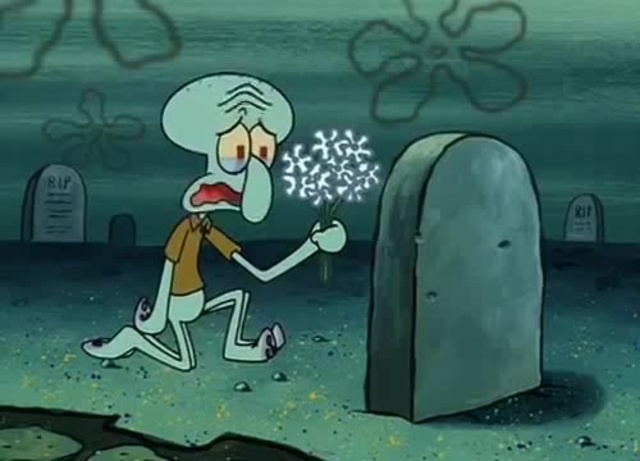
The frame comes from the episode One Krab's Trash from the third season of the cartoon SpongeBob SquarePants, which aired on February 22, 2002. Mr. Krabs sells SpongeBob a cap marked with the number one, then discovers it could fetch much more. An attempt to return the purchase leads him to a cemetery: the cap turns out to be at the grave of the previous owner. There Krabs meets Squidward, who has come with flowers.
After the visitor leaves, it turns out he was mourning his own hopes and dreams. The epitaph makes the visible grief a literal depiction of a figurative expression. In the Russian-language internet, remakes of the scene appeared as early as 2013–2014; one dated variant from January 2014 bid farewell to support for Windows XP. Later, animations, edits with other cartoons, and new epitaphs spread. These are several waves of appeal to a single scene, so the common “2015” tag does not indicate the age of the original episode.
A bouquet before a blank stone
Here a single frame is shown: Squidward in a brown shirt kneels to the left of a large tombstone, holding a bouquet. His face is tilted, his expression sad. On the right remains a wide light surface of stone; beyond it are small gravestones, some reading RIP. The green background preserves the cartoon's conventional underwater setting, although the ritual itself is immediately recognizable as human.
There is no epitaph on the large stone in this version. The empty space allows a new loss to be imagined, and the flowers explain the character's attitude toward it. A common collage of several frames adds the approach to the grave and the departure; a single image holds the middle of the action. It reads as a pause beside an already made decision: Squidward has come to say goodbye, not to find out whether the object of his hopes can still be saved.
How disappointment gets a monument
The main exaggeration lies in finality. A postponed meeting, a canceled day off, or a dead phone usually leaves room for continuation, but a tombstone declares the story finished. The joke shows precisely this excessive reaction: a small event is experienced as the wreck of an entire life plan. The bouquet adds solemnity that an everyday nuisance does not deserve in itself.
At the same time, the stone may bear not an object but a former idea of the future: “a quiet evening”, “an easy exam”, “faith in the weather forecast”. Then the character buries an expectation rather than a physical object. The meme acquires a note of self-irony: a person admits that they had emotionally grown attached to a convenience that had not yet happened. Replacing the epitaph keeps this small story intact even without knowledge of Krabs's adventures.
Three invented farewells
In a study joke the slab reads “My confidence after the first exam question.” Before the exam, the student had already mentally celebrated success, but an unfamiliar term destroyed this scenario. The flowers are addressed to self-assurance; the outcome of the exam itself remains outside the picture.
Another example: “Plans to sleep in after buying a puppy”: the tombstone mourns the former routine, not the pet. Finally, the inscription “The last free outlet on the train” after a stranger's charger appears turns a brief everyday defeat into a ceremony. These invented variants differ in the object of loss, but in all of them Squidward gives a small disappointment the scale of an event worth bringing flowers for.