what's in the picture
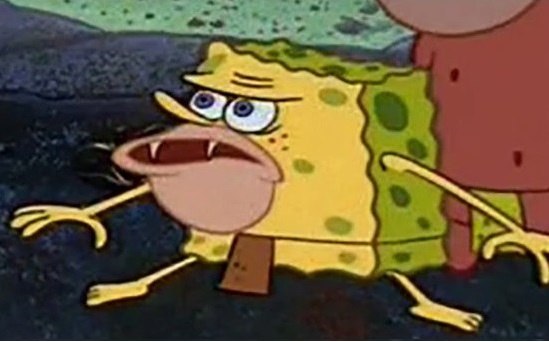
The frame shows the yellow, spotted sponge, but his appearance is drastically altered: his mouth is wide open, revealing sharp fangs, and his face is twisted into a grimace. His eyes are bulging, his brows are furrowed, and his whole expression looks sharp and aggressive. In the background, dark rocky shapes are visible, resembling a prehistoric landscape.
The character's body is bent, his arms and legs splayed out to the sides and angular, as if the creature is about to lunge at an enemy or, conversely, retreat in a panic. To the right of the sponge, a fragment of another character in red is visible, which adds dynamism to the scene and hints at the situation in the episode.
The exaggerated facial expression and sharp lines of the drawing make the frame recognizable even at a small size. This visual shorthand is convenient for conveying a strong emotion without any extra words.
origin
The character got the name SpongeGar, or Primitive SpongeBob. He appeared in the episode "SB-129," which aired on December 31, 1999, in which Squidward travels to a prehistoric era. In this version, the sponge turns out to be an ancestor of the main character, with long fangs and a loincloth, and this look quickly became memorable.
Fan projects cemented the character in the show's lore. A page about him appeared on the Spongepedia wiki on September 22, 2007, and on the SpongeBob Wiki on February 28, 2009. Thanks to these resources, the image gained details that users later played off in memes.
The exact authorship of the meme image and the first user to use the frame as a reaction haven't been established in open sources. The meme developed mostly spontaneously, through reworkings and captions, without a single creator.
spread
A notable wave was sparked by a video from YouTube user Egypt84935582, "Remembering SpongeGar," posted on July 9, 2012, which racked up more than a hundred and ten thousand views over the following four years. The clip introduced viewers to the character and established him as a recognizable cultural marker.
In 2015, a Twitter account dedicated to the sponge contrasted Primitive SpongeBob with the innocent-looking main character, and the picture quickly spread across feeds. By 2016, the frame was already being actively used on Reddit and on Black Twitter as image macros, where the character served as a visual expression of confusion and embarrassment.
The earliest known use of the picture is tied to the /mu/ community on 4chan, where on April 12, 2015, it was used in a discussion of a music group with two drummers. From there, the meme spread widely to other communities and meme sites.
typical usage
On /mu/, the picture conveys disgust and pedantic irritation, especially when it comes to a musical artist or genre that the poster considers weak. The caption usually describes a situation unpleasant to the author, while the character serves as visual confirmation of that displeasure.
In broader internet culture, the meme is used to express surprise, alarm, and embarrassment. When a person ends up in an awkward situation or gets caught off guard, the picture becomes a quick way of saying that something hard to come to terms with is happening.
Captions are often built on the contrast between a peaceful storyline and an aggressive reaction. For example, the character "explodes" over a trivial thing that wouldn't bother anyone else in a different situation, and it's exactly that mismatch that gets the laugh.
why the meme works
The meme's main strength is the clarity of the emotion. The twisted, fanged face registers instantly, and the viewer understands the reaction is intense even without a caption. The simple but exaggerated drawing stays readable at any size, which matters for quick reactions in a feed.
The second reason is flexibility. The same picture works for anger, surprise, and despair alike, so it can be used in very different situations. The caption determines the meaning, while the face sets the intensity.
Finally, there's the contrast between the image of a beloved character and a feral grimace. Viewers know SpongeBob as kind and naive, so his sudden primitive aggression looks comic and triggers recognition. This gap between the familiar character and the sharp emotion became the basis of the meme's longevity.