Who is hiding in the child's costume
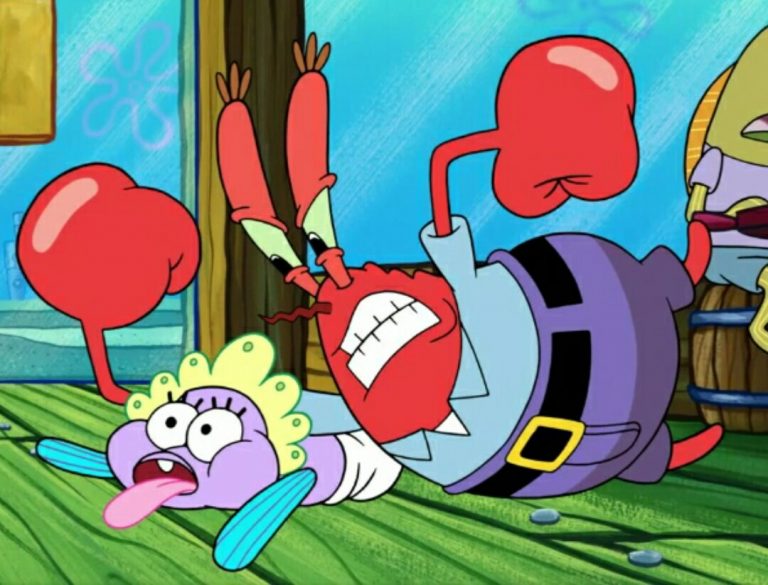
The frame comes from the episode “Plankton's Pet” of the Nickelodeon cartoon series SpongeBob SquarePants. At the start of the story Plankton makes another attempt to steal a Krabby Patty. To do this he dresses up as a little child, whom a restaurant customer is willing to help. Mr. Krabs detects the trick and throws his long-time rival out of the restaurant. The small character on the floor looks like a child because of the disguise, which creates the first misleading impression.
In June 2018 the scene began to be used as a picture with captions about confrontation. Among the early documented variants is a post by user PassivelyMassive on Reddit dated June 6. It contrasted a tragedy with a formal reaction to it. Later remakes assigned the heroes the most varied roles. The source of the picture remained the same, but the new joke no longer required any knowledge of Plankton's cunning or of his pet's later appearance.
Big claws and a small opponent
Krabs is positioned almost horizontally above the purple character on a green wooden floor. His teeth are clenched, his eyes are directed downward, and his red claws are raised on both sides of his body. The little one has wide-open eyes, a tongue sticking out, and blue flippers are visible. The edge of another customer remains beside them, but the center of the composition is occupied by the collision of two figures. There are no new captions over this frame.
The contrast in size is noticeable even before the characters are recognized. The big claws occupy a significant part of the drawing, while the opponent is pressed to the floor. Therefore the viewer easily sees an unequal struggle here. The still frame holds the windup: the expected continuation has to be imagined by the viewer. In the cartoon it is connected to exposing the disguise, while in a standalone picture it becomes an exaggerated gesture of pressure. The same drawing gets different readings depending on the role the caption assigns to the small figure.
When the response is out of proportion to the problem
The simplest scheme is a big obstacle against a weak participant. Krabs can stand for the volume of work, a strict deadline or a heavy program, while the figure below is a person or device that must cope with it. The meme conveys more than just defeat. If the role of Krabs is taken by the narrator himself, the picture can express his excessive confidence in beating a task that does not require such fury at all.
A different meaning arises when the response and the occasion are mismatched. A small mistake provokes a huge reaction, one remark turns into a long analysis, and a feeble attempt at resistance meets the full power of the system. The enormous claws make this excess of effort visible. For a good caption it matters to name both sides of the conflict: that makes it clear what proved too strong. Without such a comparison only an angry cartoon hero with raised arms remains.
Three invented collisions
In the first invented variant Krabs is “a 40-gigabyte update,” and the little one is “leftover space on an old laptop.” The big figure stands for a load that the small resource cannot match. In a second invented joke Krabs is captioned “me with a new set of cleaning brushes,” and his opponent is “one crumb on the table.” Here the narrator laughs at his own readiness to launch too imposing a struggle.
The third invented example is about an editor: the big figure is “spellcheck,” the small one is “an invented character name it doesn't recognize.” The program stubbornly fights something that for the author is not an error at all. These captions give three different shades: shortage of resources, excessive zeal and automatic pressure. In all cases the comic force is preserved in the difference in size and in the windup that clearly exceeds the modest scale of the opponent.