A rivalry that became a scale
In SpongeBob SquarePants, Mr. Krabs owns the Krusty Krab, where the main character works. Plankton runs the rival Chum Bucket, constantly tries to steal the secret formula for the Krabby Patty and outwit his competitor. The unpopularity of his restaurant is a recurring part of the story. That is why the names of these establishments had acquired opposite meanings long before the comparison pictures: one promises a familiar pleasure, the other a dubious result.
A well-known early internet example of the comparison dates to February 2016: on iFunny, restaurants were matched against American political candidates. A large wave came in March 2018. On Twitter, a version with the PlayStation 4 and Xbox spread, and then dishes, restaurant chains and apps were compared in a similar way. This is the history of the spread of a specific construction, not the date of the appearance of the cartoon buildings themselves.
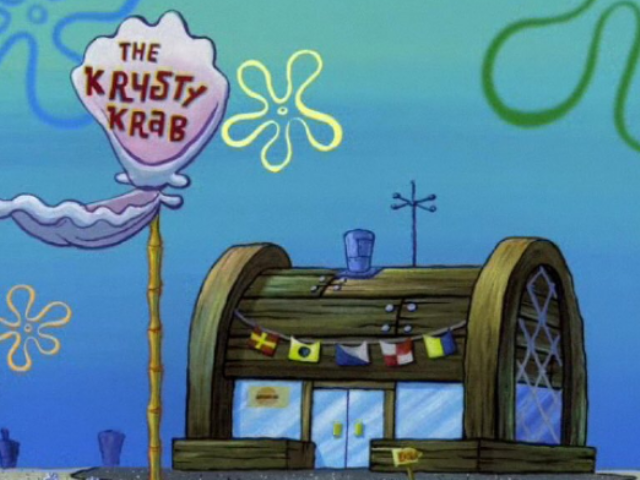
A seashell above a wooden restaurant
The illustration shows only the Krusty Krab. Above the wooden building rises a seashell with an English sign, colorful flags hang under the roof, and glass doors are at the bottom. On the right is the tall rounded part of the building with a window. On the blue underwater background float stylized flower shapes typical of the Bikini Bottom world. There is no Chum Bucket and no added product names here.
This is one half of a recognizable pair. It sets the positive role for the future comparison, but does not yet say which object the author prefers. Meme variants complete this role with a caption or logo and place Plankton's restaurant beside it. The sign acts almost like a grade: even a small name above the entrance can decide who won this fictional competition.
Why the comparison seems unfair at once
A regular table offers to compare characteristics. Here the result is built into the scenery before the items are even introduced. The author takes the reputation of the establishments and transfers it to two other things, as if they too had fought for customers for years. Such a short path to a conclusion is especially convenient for arguments about taste: detailed reasoning gives way to a recognizable jab.
The comic effect strengthens when the things being compared are almost identical. Two ways of making a sandwich receive a difference in status as if a chasm lay between them. The smaller the real reason for a dramatic choice, the more visible the author's bias. At the same time, the template is easily flipped: the second participant puts their own favorite thing on the Krusty Krab, and the earlier convincing verdict becomes its opposite.
The buildings stay constant, while the captions change. Thanks to this, a series of different pictures is perceived as one conversation about preferences. Participants argue not about the geography of Bikini Bottom, but about who gets the right to occupy the winning position.
Three small disputes
In an invented book club, a reader places the caption "Paper bookmark" above the Krusty Krab and "Dog-eared page" above the Chum Bucket. The interlocutor replies with a mirrored version: the bookmark keeps getting lost, while the corner is always in place. Two edits turn an everyday habit into a rivalry between establishments and show how much the assessment depends on the owner of the book.
A player compares "Saving before the boss" with "Hoping for luck." The first option he gives the successful restaurant. After a win without saving, a friend swaps the signs: the risk is suddenly declared a sign of skill. The joke develops through a change of reputation for one and the same action, rather than through a list of the game's features.
Finally, a company chooses music for a trip. "The playlist we put together" ends up at Krabs', "One driver's song on repeat" at Plankton's. The driver sends their own picture with the reverse distribution. The format makes the dispute visual: everyone likes their own restaurant, even though the real cause of the disagreement fits into two short captions.