Escaping Patrick, not a tough workday
The frame comes from “Nature Pants,” an episode of the first season of SpongeBob SquarePants that aired in 1999. SpongeBob decides to leave his usual life and settle among the jellyfish. Giving up clothing accompanies his dream of becoming part of nature. However, Patrick wants to bring his friend home and tries to catch him with a net. During the chase, a short pause appears by the rock: it is this moment that received its own separate meme life.
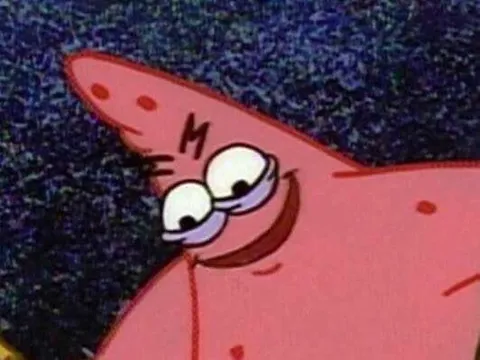
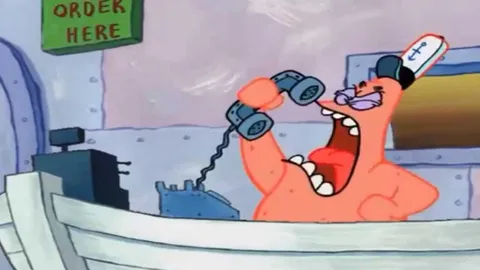
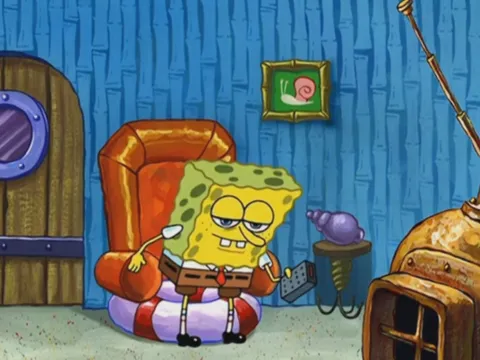
In spring 2018, the old scene began to be accompanied by captions about exhaustion. Among the early traces is a tweet by @DJJVMZ from March 22; by the end of the month, the format was already widely discussed and remade. The frame was not drawn specifically for this wave. From the same chase came Patrick's sinister expression, and later the tired SpongeBob was paired with another image of him holding money. These relatives of the format arose from different tasks: threat, exhaustion, and the comparison of expenses.
What a short pause looks like
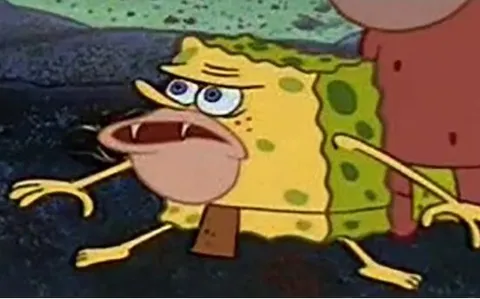
SpongeBob stands in a gap in the rock against a green clearing. He wears no usual shirt or pants, but he keeps his socks and black shoes. One hand is at his side, the other stretched toward the stone. His cheeks are puffed out, his eyes wide open, his eyebrows raised. The stone support seems to spare him from spending his last strength on balance. The image contains neither Patrick nor the net, so the viewer gets the result of the effort without the chase itself.
The figure keeps SpongeBob's recognizable silhouette even without his work outfit. At the same time, the hero's usual businesslike manner gives way to a state in which he is occupied solely with himself: stopping, exhaling, staying on his feet. This makes the image fairly self-sufficient. Knowing the episode explains the absence of clothes, but the fatigue can be read from the pose and face without recalling the whole story of life with jellyfish.
A small action like a marathon
The main structure of the caption names not a feat but the trivial thing that precedes it: “I'm after…”. A disproportion arises between cause and reaction. The cartoon exhaustion looks deserved after a long chase, but in the new story it is caused by one conversation or a few household movements. The author thereby exaggerates their own weakness, tiredness, or reluctance to start the next task.
Another variant conveys relief after an awkward situation. The hero has already escaped it but has not yet recovered. In this reading, the support of the rock becomes a sign of temporary refuge: one can linger here before returning to people. The puffed cheeks help convey a long exhale. Therefore the format can speak not only about muscles, but also about efforts that can't be measured in kilometers traveled: for example, sustaining a polite conversation.
Three original stories after the word “after”
“I'm after calling and asking what time the workshop opens.” The conversation took half a minute, yet for someone who had long put it off, it was a whole expedition. The frame gives a simple phone call the scale of a chase survived, and at the same time lets one laugh at one's own indecision.
“I'm after reading the shelf assembly instructions. The parts are still in the box.” Exhaustion sets in before any physical work begins. The detail about the box changes the expectation: the viewer first imagines successfully assembled furniture, then realizes that all the resources went into diagrams and a list of screws.
“Was going to conquer the mountain. I'm after the first step by the entrance.” Between the heroic plan and the nearest obstacle lies a huge distance. The rock behind SpongeBob supports an imaginary mountain scale, even though in the invented scene the ordeal ended almost at the door.