Where the button at the funeral came from
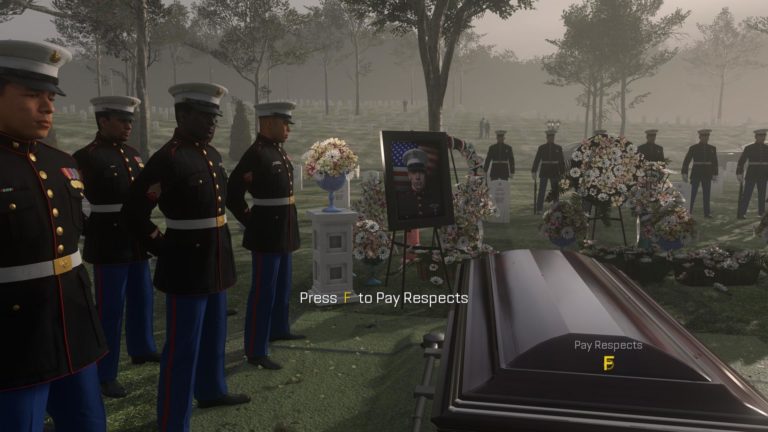
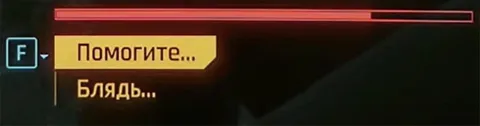
The phrase comes from the story campaign of Call of Duty: Advanced Warfare, developed by Sledgehammer Games and released by Activision in November 2014. Early in the game soldier Jack Mitchell loses his friend Will Irons; later he attends his funeral, and the game offers a separate action to express respect. On PC this was the F key. Console versions used other commands, so the letter became associated primarily with the PC version.
The scene had a serious intent: the player was meant not only to watch the ceremony but to walk up to the coffin. However, the direct on-screen prompt sharply collided the drama with the interface. To express grief, the player performs the same operation as when opening a door or picking up an item. In the short phrase this collision sounds especially noticeable: a feeling is translated into a single-button command.
The game came out on November 4, 2014, and the scene almost immediately became a subject of jokes and discussion. Early reactions mocked not the dead character but the game mechanic, which too literally asked the player to “press” at a moment of mourning. Later the expression separated from the story: the full phrase shrank to a single F in chat. Now it can mean both sympathy and a playful acknowledgment of a small failure — the meaning depends on the situation.
What the game frame actually shows
In the chosen screen the eye moves from the honor guard on the left to the coffin in the foreground. Behind it stand wreaths and other servicemen; nearby on an easel is a portrait of the fallen in a uniform cap. In the center, over the scene, the words “Press F to Pay Respects” appear, and at the edge of the coffin the prompt is repeated with a yellow letter F. So the meme doesn't just quote the game: it preserves the interface gesture itself, which is what made the phrase recognizable.
The frame looks like a staged game ceremony, not a photo of a real funeral. Within the story it is Will Irons's funeral; in memes the image often appears without names or plot, as a universal screen for expressing a reaction. When someone writes a single F, they are not necessarily joking literally about death: in chat it can be a brief “sorry,” “my condolences,” or an admission of failure. But with a real loss the same sign can sound flippant if the context doesn't support a playful tone.
Invented captions: from bugs to sympathy
Invented caption: “The site didn't save the form after an hour of filling it in. F.” Here the letter plays the role of a short sympathy for someone who lost their work.
Another version: “I pressed ‘reply all’ again instead of ‘reply.’ F in the chat.” The mechanism turns an awkward mistake into a mini-ceremony for the colleagues' lost composure.
One more invented version: “The squad almost cleared the hard level, but the last player fell near the exit. F.” The single letter supports the one who lost, while the others recognize the reference without retelling the funeral scene. The shared failure matters more here than the game's plot: the team answers the lost result with a familiar sign.
How a game line became a shared signal
The expression's popularity is explained by its compactness: a single letter can carry a recognizable reference to the scene without forcing anyone to retell it each time. In gaming communities F fits a defeat, a failed run, or a broken save; outside games it is most often understood as a brief sympathy. The mechanism resembles a shared gesture: participants know the reference, but leave room in it for different feelings. That is why the same sign easily becomes both sincere and sarcastic — the meaning is set not by the keyboard, but by the conversation around it.