What can be seen in the photo
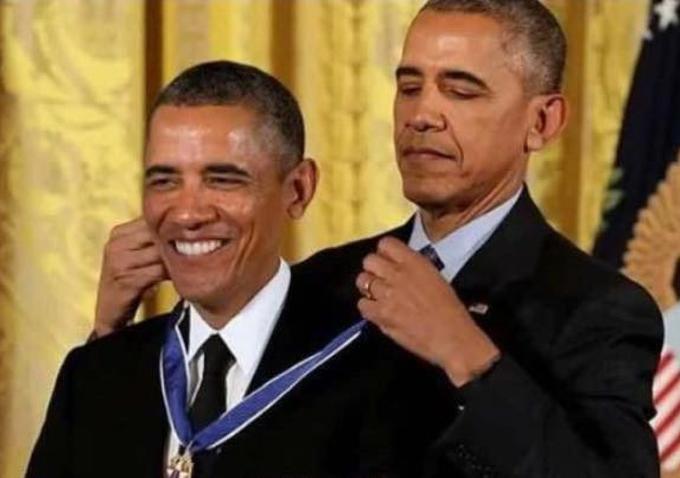
The photo shows two men in dark suits and light shirts standing against golden curtains and part of a flag on the right. The one on the left smiles broadly; he wears a blue ribbon with a medal around his neck and a dark tie. The second, closer to the right edge, with eyes closed and a calm expression, is fastening the ribbon. A ring is visible on his hand.
Both faces belong to one person, former US President Barack Obama: this is an image in which, during the presentation of an award, the recipient’s face has been replaced with the face of the person presenting it.
Where the original photo comes from
The original was shot at the Presidential Medal of Freedom ceremony on November 22, 2016, when Barack Obama honored 21 people, including Bruce Springsteen and Michael Jordan. Getty Images published many shots from that ceremony, and one of them became the basis of the montage.
The author of the edited version is unknown. According to meme reviews, on January 11, 2017 a satirical outlet published it with a caption saying that Obama awards himself a medal while saying goodbye to the office. The picture began spreading across social media at that time, and in June 2019 it had a new surge in popularity.
How the joke reads
Awards are usually received from someone else’s hands: they are a sign of recognition from outside. When the presenter and the recipient are one person, the recognition closes in on itself. The picture depicts this in complete earnest, without grimaces, and the comedy emerges precisely from the solemn setting.
The recipient’s smile and the presenter’s closed eyes complete the scene. One is happy, the other concentrates on the ceremony, and both are content in their own way. From this emerges the image of a person who praises himself and feels no embarrassment at all.
The quality of the splice plays an additional role. Lighting and scale are chosen so that without a careful look the substitution is easy to miss, and at first there is only a sense of oddness: both men look too alike. When the viewer grasps what is going on, the joke lands a second time. It is this double blow that made the picture a stable template.
What the template says about self-praise
Online, self-praise comes in two kinds: awkward, when a person genuinely expects applause, and good-natured, when a person ironically admits that the achievement is small but still wants to be pleased. The montage with two Obamas fits the second kind. It lets someone say “I’m proud of myself” without sounding smug, because the format already contains the mockery.
That is why captions in which the author praises others for their achievements come out weaker: the point of the picture is precisely that the same person gives and receives the award.
Caption examples
“Fixed my own bug and gave myself a bonus ‘for speed.’” A working-life version of self-praise.
“Me after cooking dinner from three ingredients.” Everyday pride.
“Quit smoking for a full two days. Reward for myself: a pastry.” An award handed out for very modest achievements.
“My report, graded by me as ‘excellent.’” Self-assessment with no external check.
How to use the picture
The picture works best with captions about situations where a person praises themselves because nobody else noticed the achievement. It is a kind, self-ironic story.
The montage should not be turned into a political statement or presented as an authentic photograph: it was created as a joke, not as a document. If you need a caption about real people, it is better to choose neutral everyday topics.