The frame in the chamber
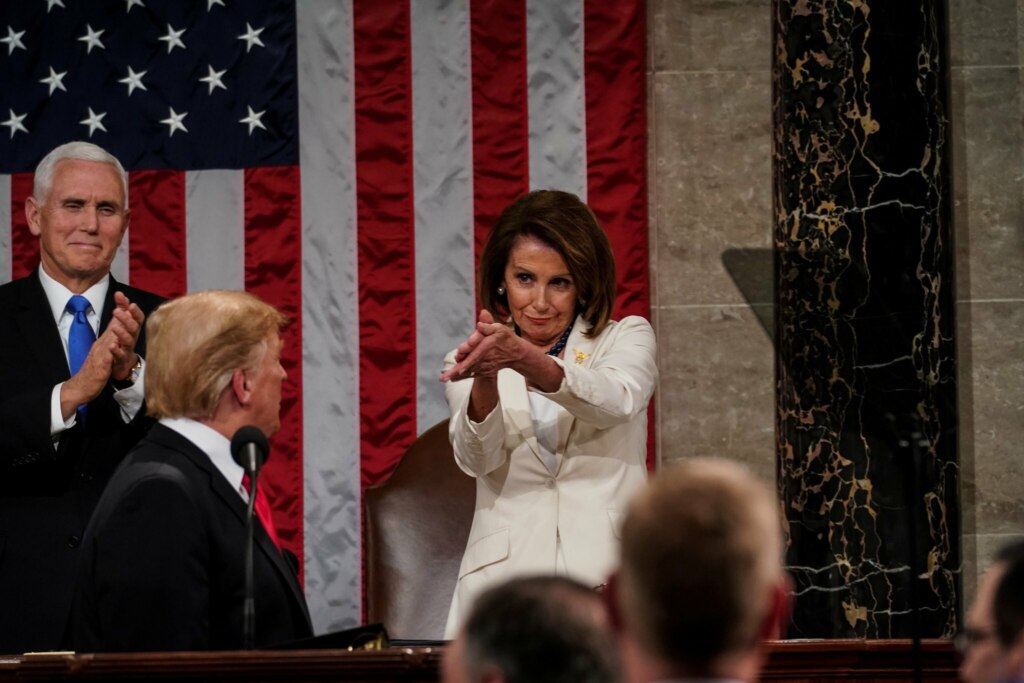
In the photo, on the left in the foreground, Trump stands with his back to the camera at a microphone, with a large American flag behind him. To the left, Vice President Mike Pence is applauding. Pelosi stands behind the podium in a white suit, raising her palms to her chest and clapping, her face calm with a barely visible half-smile. To the right behind her is a column of dark marble.
The frame itself does not explain what triggered the applause. It shows the gesture and the distance between the people: approval that appears to be directed at the man at the podium. The white color of the suit is not accidental: at the address, many Democratic women wore white, the color of the women’s suffrage movement.
What happened that evening
The address took place on February 5, 2019. The speech dealt with the economy, immigration, and political disagreements between the administration and Congress.
Accounts differ on the exact line that prompted Pelosi’s reaction. According to one version, shortly before the applause Trump called for an end to a politics of revenge and resistance; according to another, the subject was congressional investigations. Because the versions conflict, it cannot be said which phrase the gesture was aimed at.
How the gesture became a meme
The photo spread quickly on social media on the day of the speech. Viewers read the applause as mockery and started captioning the picture. It is impossible to establish which post came first.
Over time the meme became a universal template: any situation where approval sounds like ridicule was placed into it. The gesture became a short formula that even people unfamiliar with the details of the speech can understand.
Caption examples and how they work
The examples are invented for the template and are not real quotes.
“My coworker promised the report would be ready by lunch. Bravo, but with the same smile.” The gesture of approval is aimed at a promise nobody believes, and the irony comes from the gap between the words and the applause.
“My neighbor said he fixed the renovation all by himself, no help at all. Standing up and clapping.” The pause before the applause matters: the viewer has time to believe the line, then sees that the reaction does not match the meaning.
“The boss announced that this is the final deadline. Bravo, excellent work.” The official formula of praise amplifies the mockery.
The mechanism is always the same: a gesture of approval is placed next to something that is hard to approve of. So the caption works best when the text contains a promise, a claim, or a boast that the viewer immediately judges with skepticism.
What not to get wrong
Pelosi’s expression in the photo conveys an emotion that viewers can interpret in different ways. The caption “she’s mocking him” is an interpretation, not a fact about her thoughts. That is why it is reasonable to talk about the photo in terms of the gesture and the circumstances, not her inner state.
The story is tied to politics, so accuracy matters: do not attribute lines to the people in the frame that they never said, and do not transfer the caption to other politicians. The template works better when it stays tied to a specific moment.
When reusing it, choose situations where the gesture and the line genuinely contradict each other. Then the meme does not need long explanations and does not turn into a judgment of a person based on a photograph.