A meeting caught on camera
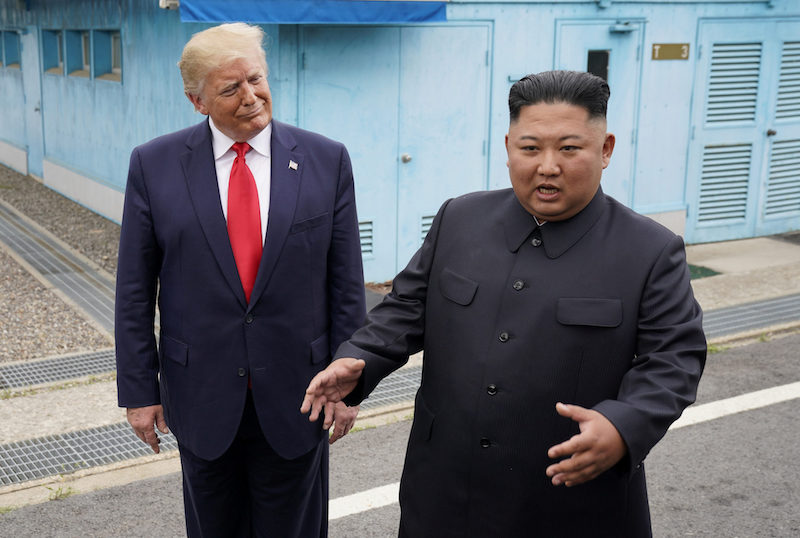
The frame is associated with the meeting of Donald Trump and Kim Jong Un on June 30, 2019, in the demilitarized zone at Panmunjom, on the border between North and South Korea. According to news agencies, Trump then became the first sitting U.S. president to step onto North Korean territory. The meeting was one of the most notable political events of summer 2019 and appeared in countless photographs.
The historical part here is only context. The meme relies on poses and facial expressions, not on the content of the conversation. Therefore, politicians should not be attributed words or intentions that are absent from official reports: the frame alone does not reveal what was discussed or what each participant thought.
What the photo shows
The picture shows two men standing on a gray path next to bluish buildings. On the left, a man with light hair in a dark blue suit, white shirt, and red tie. His arms hang down, his head is turned slightly to the right, and he looks at his conversation partner from the side with a slight smile. On the right, a man with short dark hair in a black suit with a high closed collar, buttoned up to the top: he is speaking, and both of his palms are open and extended forward, as in an explanation.
Behind them are blue walls with metal doors, one of which has a sign. Underfoot are a drain grate and gravel, and a white stripe runs across the asphalt. These details create the feeling of a border zone, and that is exactly why the photo is recognizable even without a caption.
How the template works
The strength of the frame lies in the contrast between the two figures. One speaks and gestures, the other listens with his head tilted, and his smile reads as either politeness or doubt. The captions exploit exactly this asymmetry: the speaker becomes the one explaining, the listener the one who isn't quite convinced.
Captions for this image are chosen in different ways, and there is no single established version. The author of the first captions and the date of the first such use are not given here, because they are not reliably established. Emotions on faces cannot be taken as proof of these men's feelings: the photograph captured one moment from a long meeting.
Caption examples and their mechanics
Below are examples written for this template. The first: “When you explain where the border is, and they listen with the air of an expert.” The roles are clearly assigned: one explains, the other judges, and the pause between the two poses creates the joke.
The second: “Colleague: I'll briefly tell you about the project. Forty minutes later.” The exaggeration works because the reader sees an enthusiastic narrator and a listener who is already politely waiting for the end.
The third: “When your friend tells you for the third time how it really happened.” Here the gesture of open palms becomes an everyday detail, and the half-smile becomes a sign of patience.
The fourth: “He: I have a plan. Me: mm, tell me.” The caption uses a single short exchange, and the viewer decides for themselves whether it's a good plan.
How to use the template carefully
This frame suits jokes about a situation where one person enthusiastically explains and another listens with a hint of doubt. The caption should rest on the pose and expression, not on invented lines by specific politicians. Then the joke is understandable without knowing the news agenda.
Don't use the photo to attribute personal qualities, illnesses, or relationships to these people. The meme remains a joke about the frame, not a biography of its subjects. If a caption requires facts about the negotiations, they must be checked against official reports, because the frame itself contains no such information.