The moment from election night
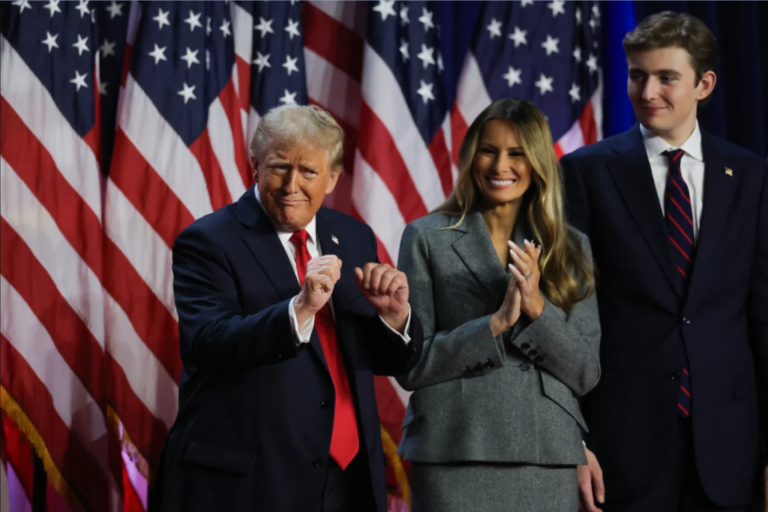
In the image, Donald Trump wears a dark suit and red tie, standing in front of a row of American flags. His arms are bent at the elbows and his hands are held in front of him, as if beginning a familiar rhythmic movement. Melania Trump smiles nearby, and their son Barron stands to the side. The setting is ceremonial: formal attire, a stage, flags, and family around the politician. It is precisely the contrast between ceremony and a slightly playful gesture that makes the image striking.
The photograph is linked to an appearance on the night after the U.S. presidential election: on November 6, 2024, Trump took the stage before supporters at a Palm Beach County convention center in Florida. Reports from the event say he appeared on stage with his family after the results were announced. Do not confuse this image with the January 2025 inauguration: similar gestures were repeated at different events, but what matters here is election night.
A repeated dance as a recognizable gesture
By this time, Trump's short dance moves had already become part of his public image. At rallies he often raised bent arms, moved them alternately in time to music, and took small steps in place. In 2024, this gesture was especially associated with "YMCA" by Village People, which was played at campaign events. The dance itself is simple and recognizable, so viewers, athletes, and video creators could repeat it without special choreography.
The meme version does not require knowing his political biography. It is enough to see someone who could not help but celebrate an event with a movement. At the same time, the original image remains political: it was taken at the moment of celebrating an election victory. Captions can use it as a universal reaction, but if the event itself is being discussed, do not present the dance as a random act at a neutral party or claim that a particular song was playing when the photo was taken unless that is confirmed.
Why the gesture easily becomes a meme
The movement consists of several simple, repeatable elements and reads clearly even in a still frame. A caption usually announces the occasion, while the image shows exuberant joy. This contrast suits situations where a result has finally arrived but celebrating feels modest or slightly awkward. Unlike a plain victory fist, there is body language and a touch of self-irony here: the figure seems to have invented his own mini-ceremony.
For example: "When I finally found the email with the right attachment — it was in the first message." The caption reveals a small victory after pointless searching, and the gesture makes it disproportionately ceremonial. Another option: "Me after clicking 'send' and seeing the file actually attached." The dance conveys relief from a familiar digital ritual. For a team chat: "The build passed on the first try — nobody touches anything until tomorrow." The joke hinges on rare success that you want to mark but are afraid to jinx.
New captions and appropriate use
The image can serve as a reaction to an unexpectedly happy coincidence: "When the bus arrived just as I reached the stop." Another caption—"Me after hearing the meeting was moved to tomorrow when I'd already left the house"—transforms the gesture into a celebratory reaction to sudden relief. In both cases the joke reads without lengthy explanation: the text names the event and the pose sets the scale of emotion.
For a caption to work, it is better to name a specific small victory or relief and not just describe the image itself. You can also use the meme without text in response to a message about completed work. If the post is about elections or politics, it is important not to hide that the scene is tied to public celebration of a victory; neutral everyday captions should be understood as transplanting the gesture into a different situation. Do not attribute thoughts to Melania or Barron that cannot be drawn from the photo: their presence here is part of the composition and documentary context, not a reason to invent family dialogue.