An airplane on a phone
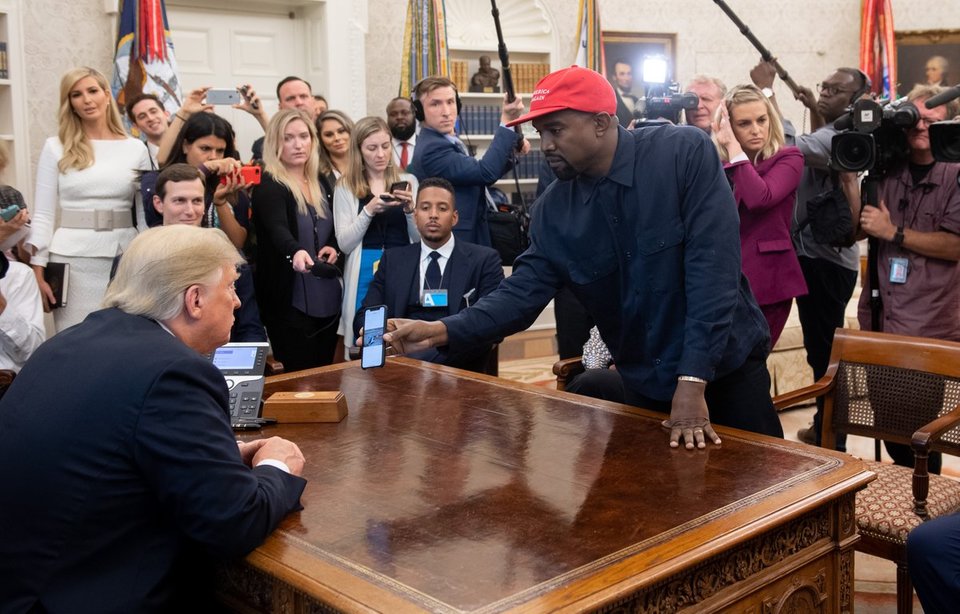
The photograph was taken during West's meeting with Trump at the White House on October 11, 2018. The screen shows an airplane concept: during the conversation, West called it iPlane 1, a hydrogen-powered aircraft that was supposed to replace Air Force One. Later, industrial designer Shabtai Hirschberg identified the image as part of his 2012 master's thesis on a future commercial airliner. This clarification helps show what actually made it into the frame: an image of a project, not an already built model.
The phone is aimed at the seated Trump, and West leans across the table so that he can see the screen. The conversation touched not only on aviation: West also talked about industry and jobs. But the gesture of showing something is easy to separate from the long meeting; it is understandable without context and recalls the familiar “look at what I found.”
The frame invites substitution
The photo has a clear composition: one person shows an object, the second looks, and the viewer sees only part of what is happening. In the meme version, the content of the screen can be replaced with another picture or message; the official photo nevertheless remains a photograph of iPlane 1. The small screen provides a convenient place for the joke, and the serious setting of the Oval Office heightens the contrast with the chosen substitute.
The direction of the gaze matters too. West seems to be explaining why the find is important, while Trump becomes a viewer inside the image. If the caption says a banking app is endlessly loading on the screen, the pause of both men turns into waiting for a payment to go through. If the screen shows a map with a route through three courtyards and a staircase, the gesture becomes an attempt to prove that the path really is short.
Two roles in one scene
The frame works as a short wordless dialogue: the presenter wants to share the find, and the viewer evaluates it. That is why the meme suits not only celebrities. One person may show a colleague an “urgent” spreadsheet with a dozen tabs, while the other concentrates on trying to figure out which version is the final one. The photo makes the viewer a third participant: we see the gesture, but the caption determines the meaning of the find.
In the original photograph, the airplane project's screen supports the official tone of the meeting. When this object is swapped for an everyday trifle, a mismatch arises between the important pose and the mundane content. When the caption keeps the seriousness, the joke can rest on the idea that the thing being shown is so complicated that the other person would need a separate presentation.
Invented captions
“When you show your dad why the bank app asks you to update right before the payment.” Here one person seems to be defending a technology while the other waits for it to finally work. “When a colleague says the file is in the folder ‘final,’ and inside there are also ‘final2’ and ‘final_for_real.’” The phone turns into a computer screen, and the gesture becomes an attempt to sort things out together.
A lighter occasion is also easy to imagine: “Found a route with no transfers — just three courtyards, a staircase, and a bus once an hour.” The captions in this section are invented. They preserve the relationship between the two figures — one shows, the other looks — while the viewer supplies the new occasion.