From ad post to photoshop
On August 6, 2018, Kim Kardashian posted a photo advertising Yeezy Boost 350 V2 sneakers in the Butter colorway on Twitter and Instagram. The model lay on a white bed in lingerie and shoes; the pose with raised, bent arms struck users as unusually rigid. The caption “Like butter” played on the colorway’s name. By August 7–8, entertainment outlets were already showing compilations of edits that moved the figure into other scenes and compared her to a toy.
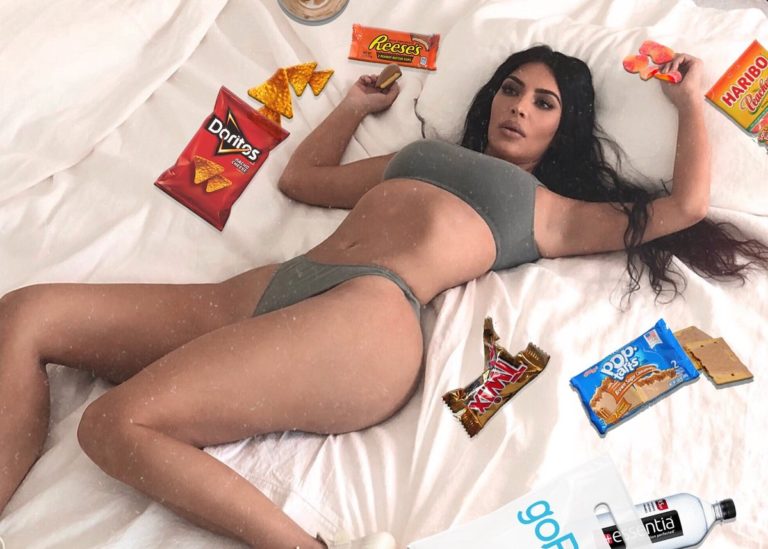
The image with snacks belongs to this wave of reworks rather than representing the original ad frame in full. The legs are cropped, no sneakers are in the visible area, but chips, sweets, packages, and a bottle of vodka have appeared on the bed. The author of this particular edit and its creation date are not established. The distinction matters for the history: the ad supplied the recognizable pose, while the everyday set around it turned a staged photo into a different situation.
What changed in the image
Kardashian lies on white bedding in gray-green lingerie. Her dark hair spills beside her head, and her arms are bent and raised. On the left is a Doritos bag, near her hand a Reese’s, on the right Haribo, below that candy bars, Pop-Tarts, and a clear bottle with a label. These objects give the reclining heroine a new setting. As a result, the luxurious staging reads as an evening with a stockpile of food, and an attentive viewer recognizes the advertising source even without the shoes.
The stillness here does not reveal Kardashian’s actual state: the caption assigns it. One viewer will see exhaustion after a long day, another full readiness to binge a series. What’s funny is how several added things change the meaning of the old pose. The figure stays the same, but the camera no longer invites admiration of a sneaker model.
The mechanics of the unexpected setting
The photoshop combines two scales: the carefully prepared image of a celebrity and the completely ordinary props of a lazy evening. The food literally surrounds the person, so it can serve as a scene of relaxation, a shopping list, or the aftermath of a run for a single candy bar. A short caption assigns the objects their role, and the abundance of packaging exaggerates that role. For a new variant, there is no need to cut out the figure again: the existing setting already allows jokes about supplies and waiting.
Three imagined situations
The caption “Bought only what’s needed for one episode” makes all the packaging a measure of self-deception. The series hasn’t started yet, but preparations have taken half the bed. The variant “Checking whether there’s enough food for the evening without delivery” gives the stillness the meaning of a serious inspection. The viewer sees a supply clearly exceeding needs, while the heroine seems to keep doubting.
For a friendly chat, “When guests cancelled the meeting but the snacks were already bought” works. Then the scattered food becomes an advantage of a solo evening, and the frozen pose becomes a moment of accepting good news. All three captions are tied specifically to this edit’s objects: they give it a more precise plot than a generic “I’m tired.” The advertising origin remains a recognizable background, but the punchline comes from the everyday situation.