Editing that doesn't need proving
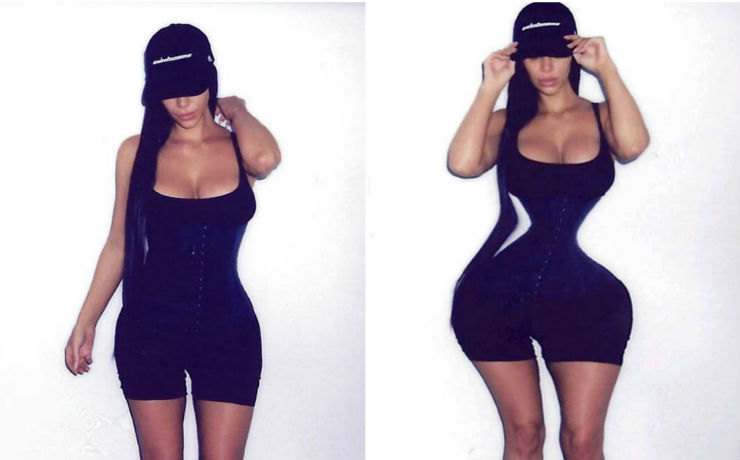
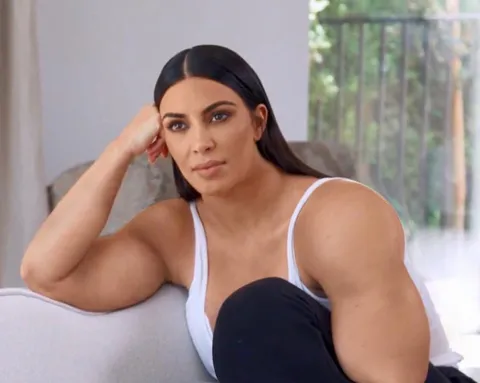
The diptych places two similar frames side by side: in the left one the figure looks more ordinary, while in the right one the silhouette of the waist and hips is sharply altered. The cap covers the eyes and the background is nearly empty, so attention goes to the difference between the bodies. The picture does not ask the viewer to work out whether it was edited: the exaggeration is the joke. The caption flips the expected line — instead of admitting the obvious editing, it pre-emptively casts critics as ill-wishers who will call the photo fake anyway.
In March 2017, Kim Kardashian posted a deliberately altered photo on Snapchat with a line saying haters would say it was photoshopped. This specific episode helped tie the formula to her name. However, a similar English-language phrase was used in other memes before that: for example, in 2012 a line saying “haters will say this is fake” was applied to videos of trick throws. Therefore, Kardashian should not be presented as the author of the whole construction.
Two versions, one obvious difference
A before-and-after comparison gives the viewer visual proof that is usually missing in arguments about fakery. The figure on the right is grotesquely altered, and the caption plays on the gap between this obvious editing and the familiar excuse “it's just nitpicking.” The irony does not require accusing a real person or drawing conclusions about her appearance; it targets the mismatch between the picture and the formula. The more striking the difference between the two frames, the clearer it is that the author is joking precisely about the rhetoric of defending an obvious edit.
Later, the same text was put under other deliberately altered images and under unexpected photos where viewers argued about whether the image was real. In one case the caption confirms the editing; in another it feigns dismissing doubt. This ambiguity gives the template two tones: self-irony by an author who shows an obvious photo-spoof, and mockery of a commenter who declares anything unusual-looking to be edited. What sets the difference is not the face in the photo but the context and the degree to which the editing is obvious.
From a personal caption to a general formula
Kardashian used this phrase about her own Snapchat photo, and news outlets widely spread the story in March 2017. So a personal post ended up next to a more general internet joke about obviously fake images. The Russian retellings settled on the translation “Haters will say it's photoshop,” but it can be attached to anyone and to any edit. The specific photo is recognized by the contrast of two silhouettes; the universal template can work without the original picture and without the celebrity's name.
The word “haters” matters too: it replaces a calm description of the editing with talk about a hostile audience. The person does not discuss the quality of the edit, but seems to pre-discredit those who would notice it. In an innocent remake this is self-irony; in a real argument about a photo, such a phrase does not prove whether the image was edited. Here it serves a comic contrast between obviousness and justification.
The examples are invented
Invented caption: “Haters will say I gained ten centimeters of height” — next to a photo where an editor stretched the character up to the ceiling. The exaggeration is open, and the author winks at the viewer. Another variant: “Haters will say this seven-tier cake was drawn” — under a photo of a real, but almost impossibly tall dessert. Here the phrase plays on doubt without accusing a specific critic.
Third scene: a person shows two photos of the same room before and after tidying up, and the caption claims order was achieved with a single click. If the second frame shows painted windows and a staircase, the editing is obvious; if the changes look plausible, the joke depends on the author's knowledge. These examples are invented and do not refer to Kim Kardashian. They show how one phrase can either admit a photo-spoof or pretend the viewer was wrong to notice it.