Six pictures and a shared taste
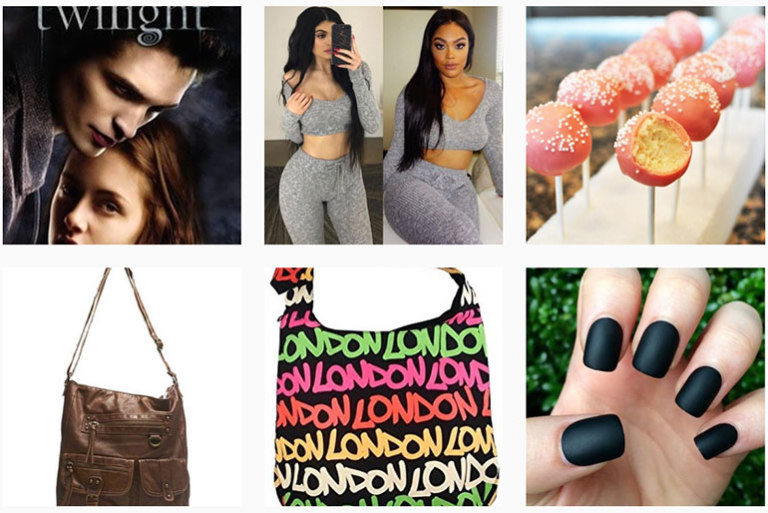
This meme is a grid of six photographs. At the top left is the cover of the film Twilight with its title and a close-up of a couple. Next to it are two women in matching gray suits, shot in selfie style. On the right are pink cake pops on sticks with white sprinkles. At the bottom is a brown crossbody bag, a bag with bright multicolored London lettering, and hands with black matte nail polish.
The set is chosen to show the word without explanation: in front of the viewer are things that were once at their peak and now read as “trying too hard”.
A word from Los Angeles
According to reference material, the word was coined in 2013 by Gaby Rasson from Los Angeles, when there was no word in conversation for something unfashionable. For years it remained a narrow in-group word of her circle. It spread widely after TikTok creator Holly Kane wrote about it on 30 March 2021, and the hashtag passed 10 million views by mid-May.
On 29 April 2021, journalist Taylor Lorenz published an article about the word in The New York Times, after which TV and major media picked it up. By early May, jokes had appeared that cheugy itself had become cheugy because of excessive hype.
What the word means and why it is disputed
Cheugy describes not simply the old, but what tries to keep up with fashion and is a little late. That is why the word was often pinned on millennial tastes: rose gold, skinny jeans, motivational wall lettering.
The word has a downside too. It implies that some tastes are “right” and others are laughable, and commentators often noted that the judgment depends on age and social circle. It is not worth using it as a diagnosis of a person: it is a joke about things and habits, not about personality.
The word has no settled Russian spelling: texts use both the Latin spelling and the variant “chugi”. So in captions it makes sense to explain once what is meant and then use either spelling.
How the meme answers the word
A grid of six pictures is a typical answer to “what is cheugy?”. The author does not explain; they show a display case. The viewer recognizes a couple of things from childhood and arrives at the definition on their own.
The same device works for any evaluative words: “vintage”, “cringe”, “normie”. You need to assemble a set of pictures that explains the word better than a definition does.
Caption examples
“My room in 2014.” Six things turn into a museum of one's own taste.
“What TikTok would say about my playlist.” Album covers can be substituted for the pictures.
“Cheugy, but I still love it.” A self-irony variant: the word is applied to oneself and loses its sting.
“Mom getting me ready for school in 2009.” The device works through recognition: everyone has their own set of things that now look outdated.
Tips
The word is best used ironically, about oneself or about things rather than as an insult to people. Also, it is tied to 2021, and in a few years readers may no longer know what it means, so it makes sense to keep a short explanation in the caption.