What the photo shows
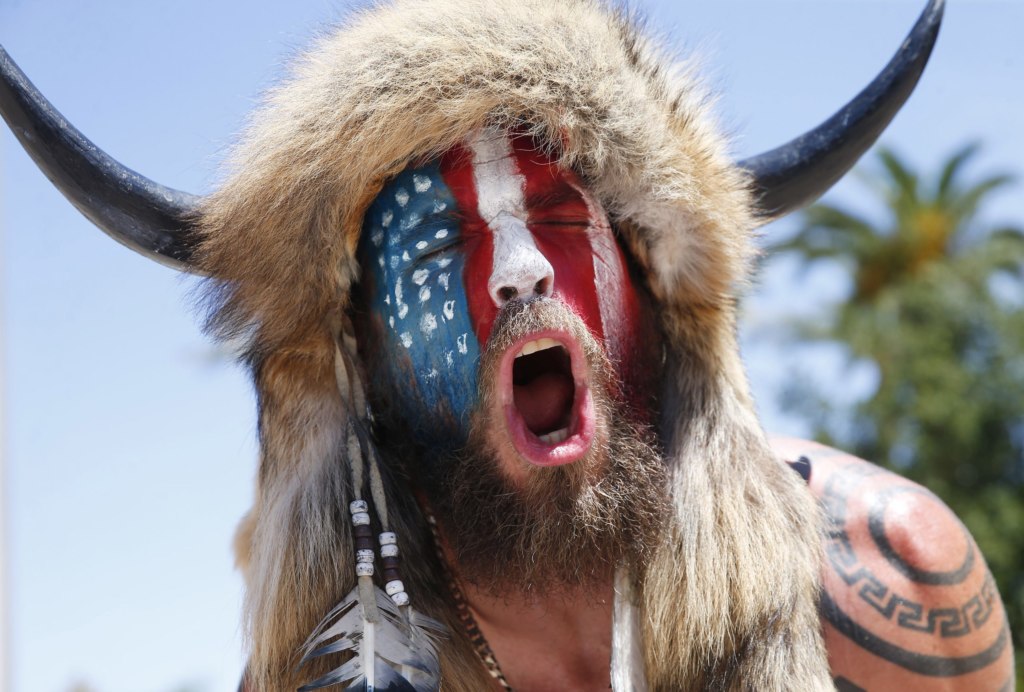
The shot is a close-up against a blue sky and a palm tree. The bearded man has his eyes closed and his mouth wide open, as if he is shouting or singing. His face is painted: one side in blue with white stars, the other in red and white stripes. On his head is a bulky fur piece with two black horns, while beads and feathers hang by his temple and a tattooed ornament is visible on his shoulder.
This is an uncaptioned portrait photo. It was not taken in Washington: according to reports, Chansley is shown at a rally in Arizona, that is, before the storming of the Capitol. For the meme what matters is the mix of national symbolism, shamanic-Viking gear and a shout with closed eyes. Viewers instantly read a person who is fully absorbed in his own role.
Who this is and how the Capitol fits in
The man's name is Jacob Anthony Chansley. Online he is most often called Jake Angeli, a stage name he used himself. He attended rallies by supporters of Donald Trump and was linked to the QAnon conspiracy theory, hence the nicknames “QAnon Shaman” and “Viking Man.”
On January 6, 2021, a crowd broke into the United States Capitol building in Washington. Chansley was among those who entered: he had a painted face, a horned fur headdress, no shirt, a megaphone and a spear with a flag tied to it. Photos from the Senate chamber spread across world media. In September 2021 he pleaded guilty to obstructing an official proceeding, and on November 17, 2021 he was sentenced to 41 months in prison. On January 20, 2025 he was pardoned as part of a mass pardon of participants in those events.
Why the look became a meme
The main reason is visual contrast. The man came to a serious event dressed in a costume better suited to a festival or a film about Vikings. The mismatch between the scale of what was happening and the hero's appearance became material for jokes.
Most captions mock not specific views but the situation of “showing up to an important matter in the most inappropriate outfit.” It is important to distinguish: the joke targets the image from the photo, while the real events of January 6 remain a serious episode of American history that ended in court sentences.
Caption examples and how they work
“Me when the call said the dress code is relaxed.” The caption uses contrast: the word “relaxed” is taken too literally, something anyone who has mistaken a relaxed dress code for total freedom will recognize.
“Coworker who sees that the last slice of pizza is still in the office.” Here the shout in the picture turns into everyday excitement, and the gap between the occasion and the reaction creates the comedy.
“When you had weekend plans, but your friend texts: ‘Let's keep it quick.’” The face expresses doomed enthusiasm, and the caption adds a familiar occasion.
“Monday morning: the work chat is already open.” The painted face reads like war paint, and the chat becomes a battlefield.
How to use this picture
The image works best in everyday situations: overly emotional reactions, excessive preparation, solemnity where it isn't needed. A short caption is enough, since the picture fills the space itself.
Keep in mind that behind the image are real events and a real convicted person. Captions that turn the photo into a joke about violence or about victims sit poorly with the source of the image and leave an unpleasant impression. Everyday jokes about exaggerated reactions get the comic effect without that.