What the screenshot shows
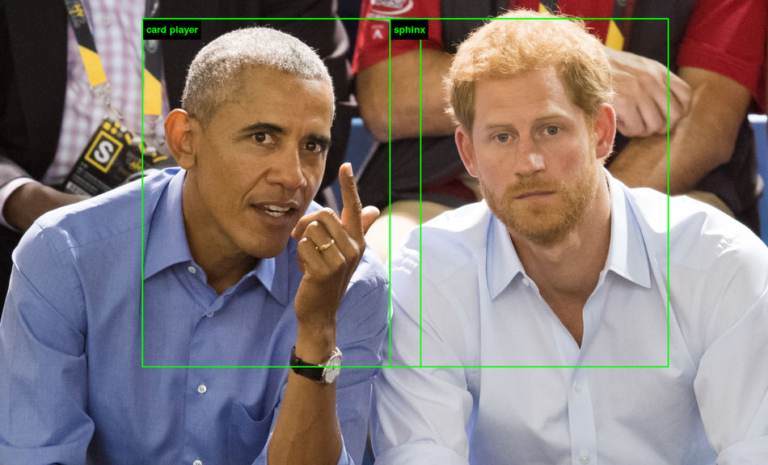
Two men sit shoulder to shoulder. On the left, a man in a light blue shirt is talking animatedly and raising his index finger. On the right, a man in a white shirt with a short red beard looks straight into the camera. A green box is drawn around each of them, and the boxes overlap. Above the left one is the label “card player,” and above the right one, “sphinx.” Behind them, spectators in red shirts are visible, suggesting the photo was taken at a sporting or public event.
The captions look comical: men in shirts get labels from a card game and from mythology. These absurd labels are what made the screenshot popular.
What ImageNet Roulette is
ImageNet Roulette is a web project launched in September 2019 as part of an exhibition at the Fondazione Prada in Milan. A user uploaded a photograph, and the system searched it for a face and assigned that face a label from a set of categories, around 2,500 options in total. The neural network was trained on part of the ImageNet data, a database of more than 14 million labeled images created at Stanford, in which people were described using the WordNet vocabulary.
Importantly, this was not an entertainment service but an art project with a critical purpose. The creators wanted to show how biased and outdated categories make their way into machine vision systems. They noted that people rarely see how algorithms classify them.
Why the project went viral
On Twitter, participants posted their results under the hashtag #ImageNetRoulette. Reportedly, at its peak the service was producing more than 100,000 labels an hour. Some of the answers were funny, some strange, and some offensive: for example, people with dark skin were often given insulting or degrading words. That was precisely the main point of the project.
So the playful screenshots like “card player” and “sphinx” are just the tip of the iceberg. Users enjoyed the fact that the neural network confidently delivered an absurd definition, but behind the funny surface was a serious issue about what training data is built from.
How to treat this meme
An AI meme works well as a joke about algorithmic overconfidence: the system doesn’t hesitate and doesn’t apologize. But it’s important to remember that the result is not “the computer’s opinion of a person” but a reflection of specific labeling and a specific vocabulary. That is why captions in the spirit of “the neural network saw me as…” always come with the understanding that AI makes mistakes.
It’s best not to use screenshots with offensive labels: in that case the joke can easily turn into humiliating real people. The safe option is absurd but harmless labels like “sphinx.”
Caption examples
“When a neural network identifies you as a sphinx, and you were just thinking about what’s for lunch” — AI lends mystique to an everyday moment.
“Artificial intelligence looks at me and my friend: one a card player, the other a sphinx. Roles assigned” — a joke about a pair of friends.
“The algorithm sees what I can’t” — irony about the system finding something strange in an ordinary photo.
“I uploaded my photo, and it asked who here is the card player” — the caption turns the AI’s mistake into a dialogue.