the Cookrate video, its Russian translation, and markisuplo's edit
The basis was an ordinary recipe: a pocket is cut into a piece of meat, stuffed with butter, and the meat is brushed with butter on the outside as well. The English-language short video, titled "A single ingredient and the meat will melt in your mouth," came out on September 14, 2025, on the channel Cookrate — Meat Recipes.
In September a translation appeared on a Russian-language channel on Dzen under the title "One ingredient — and the meat will melt in your mouth like butter." The opening lines were translated almost word for word, and at that point nothing in the recording was funny yet.
The joke was put together by a TikTok user going by markisuplo: on September 16, 2025, he posted his own edit, in which the brushing-with-butter step repeats after every single action. The clip racked up more than ten million views and around seven hundred thousand likes. Publications differ on the comment count, citing both 25,000 and 28,000. The original recipe never came close to those numbers.
what exactly gets repeated in this clip
There's only one device here, but it works on sound. Between short commands, the same line keeps sounding again and again: brush the meat with butter, slice the garlic, brush the meat with butter, add salt, brush the meat with butter. The instruction stops being an instruction and turns into a loop.
Phonetics reinforce the repetition. In Russian, the words for "meat" (myaso) and "butter" (maslo) sit close together and differ by a single consonant, so they're easy to swap by ear. In the comments and in new versions, mangled variants appeared — "brush the butter with butter," "brush the meet with butter," "brush the mear with mutter" — not a translation error, but a deliberate mangling of the phrase.
The advice itself is harmless: brushing meat with butter before roasting is standard practice. What makes the phrase funny isn't its content but its frequency.
the frame: butter wrapped in meat
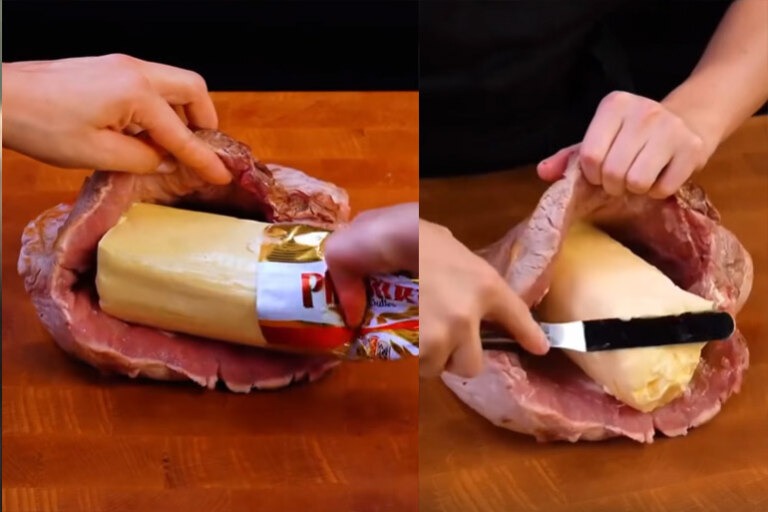
The meme is represented by a collage of two shots. On the left, a thin slice of raw meat lies on a wooden board; a whole stick of butter is placed on it — the wrapper half-peeled, a large red letter and gold foil on the white label — and the meat is folded over the stick. On the right, the meat with the butter is held in a pair of hands, and a knife spreads the butter across the inside of the slice. No people are visible in the frame: only hands, forearms in black clothing, and the edge of a table can be seen.
The meme is only partly AI-driven: the picture shows footage from an ordinary filmed video, and the AI-generated reworkings came later, once the trend was already underway. The meme's main joke — the repeated brushing — isn't visible in the frame itself: all you see is butter wrapped in meat.
"brush the meat with butter" in captions
Captions for this template are built on bringing back the same line after any other action.
"Brush the meat with butter. Open your email. Brush the meat with butter. Reply to the message. Brush the meat with butter" — a workday in which one single duty keeps wedging itself into everything else.
"Brush the butter with butter" — for a piece of advice that explains nothing to begin with.
"First brush the meat with butter, then brush the meat with butter again, and the rest however it goes" — for a schedule where one item has taken up the whole day.
The device works by flipping the reader's expectation: you wait for the next step and get the same line instead. The longer the list of actions around it, the more noticeable the glitch.
AI reworkings and other people's versions
Once the clip spread, reworkings followed: some swapped meat and butter around, others ran the phrase through a neural network and got new mispronounced variants. The online marketplace Ozon made its own version, and streamer Bratishkin reacted to one of the garbled voiceovers.
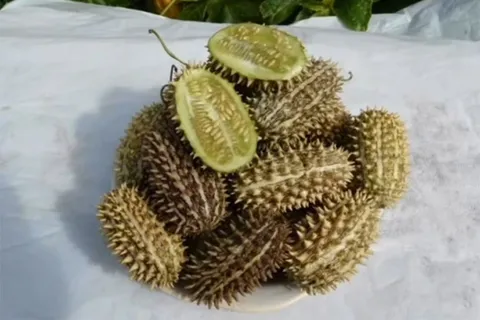
By type, the meme is closest to "the Wild Cucumber": there too an absurd, repeating phrase does the work, detached from meaning. The difference is that meat and butter have a real culinary source that's easy to find — so the joke makes sense even to those who never watched the recipe.