A roll that turned out to be cake
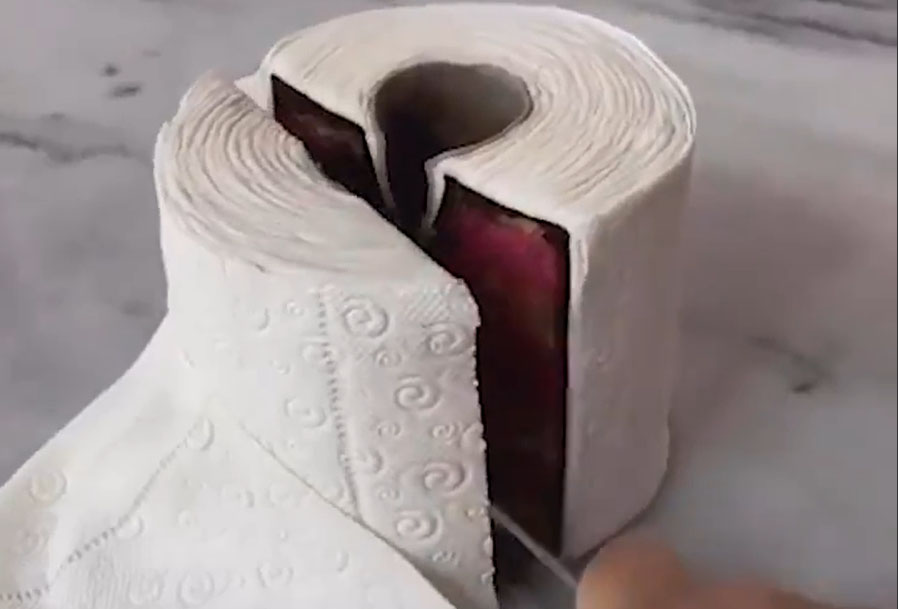
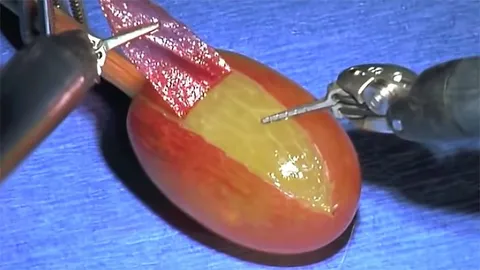
The picture shows in close-up a roll of paper with an embossed pattern on the sheets. A wedge has been cut from it: the edges of the cut are even, inside is a layered dark red filling, and in the lower corner a knife and part of a hand are visible. The background is light, resembling a marble countertop.
The main device is the deception of expectation. The viewer sees an everyday object and is sure they know how it is made. The knife cuts it easily, like a sponge cake, and the picture breaks: in front of us is not paper but a dessert.
The “Is It Cake?” wave of summer 2020
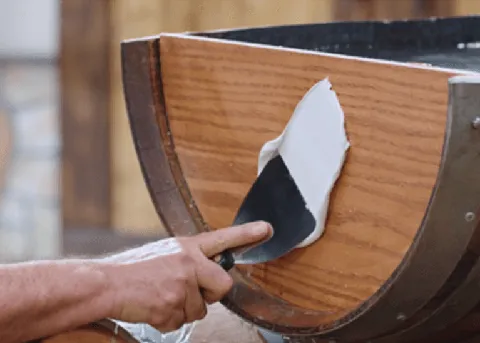
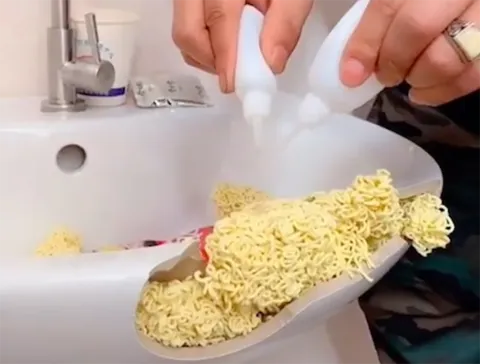
In early July 2020, a video of hyperrealistic cakes spread across social media. Among those who make such desserts is Turkish confectioner Tuba Geçkil, whose cake shaped like a Crocs clog became especially widely known. Then the Tasty account posted a compilation in which a knife cuts open all sorts of objects, and jokes poured in like an avalanche.
The compilations and discussions mentioned purse-shaped cakes, coffee-cup cakes, toilet-paper-roll cakes, and others. Western publications linked the popularity to the mood of that year: people spent a lot of time at home, the news feed was anxious, and the absurd idea that “everything around might turn out to be cake” worked as a release.
How a video became a meme
The video itself was already a bit eerie and a bit pleasing: the knife passes through an object and it turns out to be soft. Joke-makers went further: they started adding the question “but is this definitely not cake?” to captions under any pictures, from photos of furniture to portraits of celebrities. One of the common variants: “Look at your neighbor, they might turn out to be cake.”
The joke requires no knowledge of context: it is enough to see an ordinary object and believe it can be cut. This made the meme easy to retell and quick to spread.
Why it is funny
The first layer of meaning: we are used to trusting our eyes. The meme sets this habit against a fact: in a world where perfect fakes can be made, one cannot be sure of anything.
The second layer: everyday absurdity. Toilet paper is associated with something quite unappetizing, and cake with a celebration. When they swap places, the brain loses its footing for a second, and it is this pause that provokes laughter.
The third layer: self-irony. People joked that they themselves might turn out to be cake, thereby playing with the anxiety and uncertainty around them.
Caption examples
“My salary after deductions: check whether it’s definitely not cake?” The object is replaced with an abstraction, while the question stays the same.
“I look at my to-do list and suspect it’s cake: too layered.” An everyday problem described as a confectionery product.
“Don’t cut this sofa, it might be cake.” A direct reference to the joke: any object gets the status of a suspect.
“The cat sleeps in the pose of a pastry, so it’s cake.” A living creature undergoes the same doubt, and the absurdity grows.
How to use it
The template works best in two variants. The first: a pair of frames where an ordinary object sits next to its cake double. The second: a single picture with a question caption. There is no need to explain the joke; it is enough to show a suspiciously even cut.
If you make your own version, choose objects that could really be imitations: a glove, a candle, a book. The better the object suits the role of “fake,” the more effective the cut and the fewer words are needed.