What is depicted
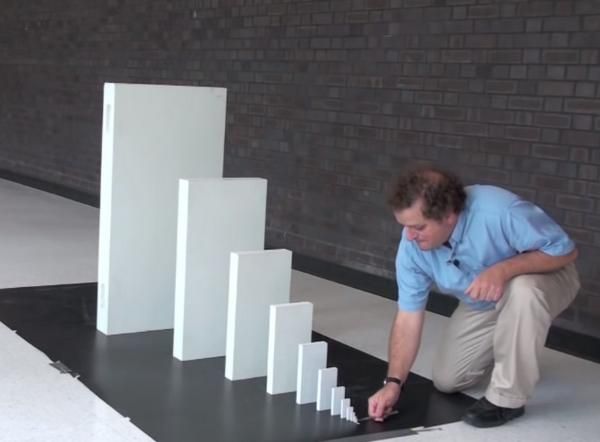
A man in a blue shirt and beige pants is crouched on a dark mat on a light floor. In front of him stands a row of white rectangular tiles: the tallest stands furthest away, and toward him they get smaller and smaller until they become tiny. The man’s hand is at the smallest tile, so the frame captures the moment just before the launch.
A brick wall forms the background. The picture shows preparation, not the fall, and this matters for captions: the joke is built on anticipation rather than on a finished result.
Where the image comes from
The frame comes from an educational video published on 4 October 2009. Its author is reportedly the physicist Stephen Morris from the University of Toronto, who ran an educational channel. He demonstrated how a chain of tiles, each about one and a half times larger than the previous one, allows a tiny tile to ultimately topple a giant one.
The principle is simple: a tile standing upright stores potential energy, and when it falls it has enough force to knock over its neighbor, which is slightly bigger. The energy grows at each step, so a small push can lead to an enormous result.
How the frame became a template
According to reports, a version with captions on the objects appeared on Reddit in July 2018, and the picture spread widely in December of that year: captioned variants gathered tens of thousands of votes in popular communities within a couple of weeks. After that, the template moved to other social networks.
The principle of the template is simple: the tiles are labelled as links in a chain, from a harmless cause to a huge consequence, and the picture reads as a story about escalating consequences. Different versions vary in wording, so each has its own tone.
Examples of captions and how they work
First tile: “Fine, I’ll do it later.” Last tile: “An evening renovating the whole flat.” The caption rests on cause and effect: a small decision drags an enormous result behind it.
“Opened one browser tab” → “Monday came and I wasn’t there.” This is exaggeration: the first action is harmless, while the ending looks like a catastrophe. The bigger the gap in scale, the funnier it gets.
“One reply in the chat” → “A three-hour call.” Time compression works here: a short action turns into a long episode, and the growing tiles echo that escalation.
“One glance at the to-do list” → “An hour later, a two-page list.” The viewer understands that the first link looks harmless, and this sets up the unexpected ending.
Tips for use
The frame suits stories about accumulating small things, chains of decisions and unexpected consequences. It works when the captions build an order from small to large: the picture itself suggests movement from the right edge toward the left and reinforces the sense of growth.
Do not caption the pictured man as the hero of an anecdote: this is an educational demonstration, not a portrait, and the joke should be about the row of tiles and the chain of events. The most successful captions make the last link noticeably larger and more unexpected than the first, with the intermediate links logically connecting them. If the consequences are too similar in scale, the sense of escalation disappears and the picture turns into an ordinary list.