What the photo shows
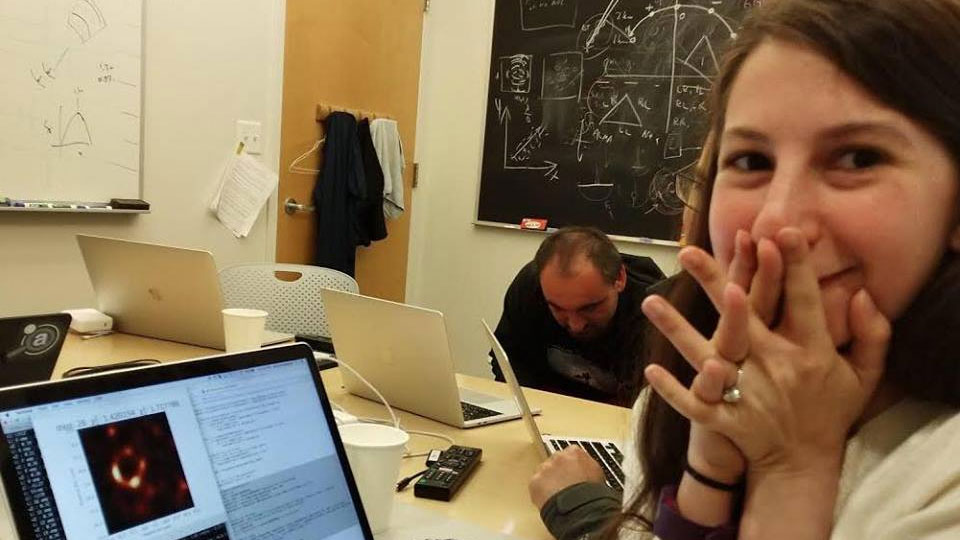
In the foreground on the right a young woman with dark hair looks into the camera and smiles. Both hands are raised to her face, her fingers covering her mouth; a ring is visible on one hand and a dark bracelet on her wrist. Her gaze is lively, and her pose expresses unexpected joy or embarrassment.
Behind her is another person leaning over a laptop, and several laptops on the table. On the left is a white board with diagrams, and on the right a black board with drawings and formulas. On the screen of the laptop in the lower left corner of the frame a dark image with an orange ring glows: this is a picture of a black hole, with lines of text beside it.
The photo was taken in an ordinary work room without studio lighting, so it looks like a frame from a laboratory rather than a staged portrait.
Who is in the photo and what happened
The subject is Katie Bouman, a researcher who took part in the project that produced the first image of a black hole. She posted the photograph to her account on the day the result was announced, 10 April 2019, and soon the picture spread across social networks and forums with captions crediting her as the creator of the first black hole image.
Bouman was part of the team that developed the algorithms used to produce the image. The image itself was the result of the work of a very large international group and several radio telescopes, so captions should not attribute the whole project to one person. Exaggerated claims about her role quickly appeared around the photo, and that is also worth remembering.
The meme rests on emotion, not on biography. That is why jokes usually do not touch on the science itself and work as a general reaction of delight that can be carried over to any situation.
How the template works: the screen changes
The photo on its own conveys a strong reaction: hands at the face, a smile, an open gaze. The stronger the emotion, the easier it is to put any object on the screen and see how the reaction becomes funny.
The usual scheme is this: the author replaces the image on the laptop screen with a picture that the woman supposedly sees. This is how variants with a game, a dating app, a slideshow, or a delivery tracker appear. The emotion stays the same, while its cause changes.
This is the secret of the template: the viewer first sees the delight and only then understands what it is directed at. The pause between these two steps is what produces the laugh.
Examples of captions for different screens
Below are captions built around the screen rather than the face.
A screen showing “You have a new match!” from a dating app. Caption: “When someone finally replies first.” The change of scale works: the same delight as at a scientific discovery is directed at a very personal event.
A delivery tracker screen where the pizza is already at the neighbouring house. Caption: “The courier is on the stairs, the most important moment is coming.” The contrast between the solemn tone and an ordinary dinner gives a gentle irony.
A screen reading “Game over.” Caption: “Why the last level didn't count again.” The emotion shifts from delight to annoyance, and the viewer sees the same pose in a different context.
A slideshow screen with rapidly changing images. Caption: “Every slide is newer than the last, and I still don't understand what is going on.” It is funny because the delight is aimed at chaos rather than at an achievement.
How to assemble your own selection
Pick a screen that sharply contrasts with the scientific subject: a game, an everyday service, a funny interface. If you choose a screen close in meaning, the joke becomes dull.
The caption is best kept shorter than the screen itself. A long phrase dissipates the effect, because the viewer has already taken in the scene. One precise phrase that explains the change of context is enough. Do not use the photo in a way that mocks the researcher herself or her work: the template is about delight, not about the person.