What is visible in the frame
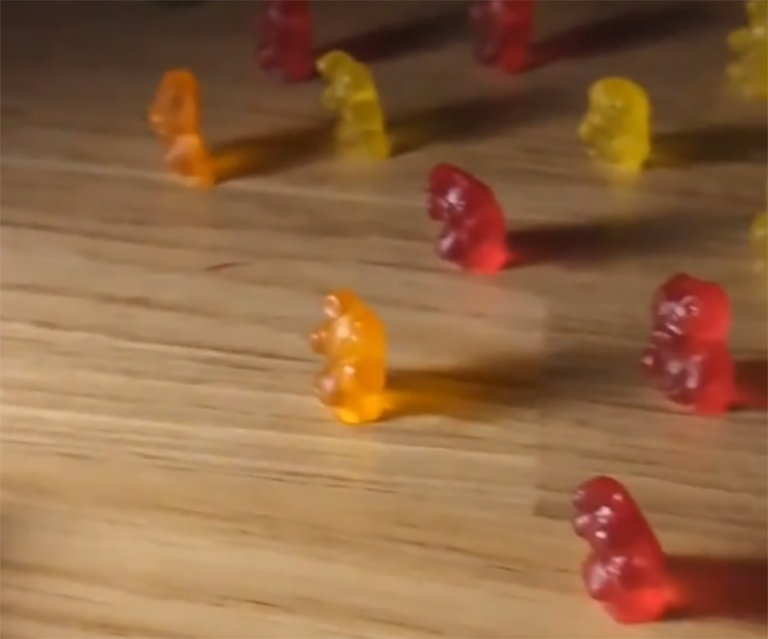
The image shows several gummy bears in orange, red, and yellow. They stand on a light wooden surface, each casting a soft shadow, and some of the figures at the edges of the frame are cut off. The bears in front are clearly visible, the distant ones slightly blurred. There are no people, inscriptions, or captions in the image.
The scene is built on scale: the bears are placed at different distances from the camera, and the eye itself turns them into an audience hall. They all face the same way, as if listening to a speaker.
How the flash mob started
The flash mob is called the “Gummy Bear Challenge.” It reportedly appeared in the first days of January 2019 on social networks: the video shows many gummy bears as if they are “singing” a song, with one starting and the others joining in. The exact date and the author of the first video are not reliably established, so it is more accurate to speak of early January 2019 as the period of mass spread.
Then variations followed: users repeated the idea with toys and other small objects, turning them into a “choir” or an “audience.” The main thing about the format is not exact repetition but the chance to assemble your own crowd from whatever small items are at hand.
Why a crowd of small things is funny
The laugh comes from the gap between scale and the seriousness of the presentation. A concert on an ordinary floor looks absurd, but it is staged as if everything were real: one “performer,” and the others “listen.” The viewer picks up this contrast between toys and concert staging on their own, and the enjoyment comes precisely from that recognition.
Tempo matters too. In a video the audience usually does not reveal itself at once: first one hero, then it becomes clear that a whole crowd surrounds him. A static frame conveys only the second half of this device, the crowd itself, but makes it visible at first glance.
Caption examples
Below are invented captions. In each, one hero is in the foreground and an “audience” surrounds him.
“The front row that is sure it hears every note.” The caption attributes self-confidence to the bears, and the contrast with their tiny size creates a comic effect.
“Office party, when the boss asked for ‘something heartfelt.’” This example moves the flash mob into the office: high expectations and modest means are combined in one phrase.
“My cat, when it opened the fridge and saw a crowd of fans.” Here the joke relies on exaggeration: the animal becomes a star, and the other objects serve as the audience.
“When everyone in the chat is silent, then one person writes, and twenty reply at once.” The caption shows the group effect: all it takes is someone to start.
How to use this frame
The picture suits stories about fans, small spectators, household toys, and table arrangements. A viewer best reads the idea when the caption has one hero and a crowd, rather than a long list of characters.
A static frame is weaker than a video, so the caption should convey motion: “sings,” “joins in,” “everyone is watching.” Then the picture comes alive, and the joke holds up on a single image without explanation. If you need to tell the story of the flash mob, stick to what is known: the time of spread and the general principle, not exact names or view counts.