An ad slogan out of body horror
The question became recognizable thanks to Coralie Fargeat's "The Substance," which premiered at the Cannes Film Festival in May 2024. In the film an aging celebrity takes an unknown substance that creates a younger version of her. The official teaser is framed as a direct address to the viewer: they're promised the "best version" of themselves, and then shown a strange substance. From the film, the phrase moved into short videos and side-by-side comparisons.
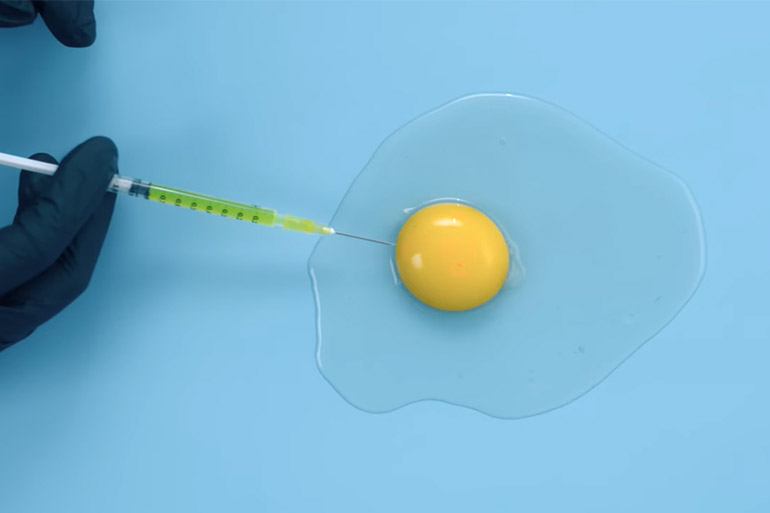
This isn't a frame with the actresses in it: against a blue background, a gloved hand inserts a needle into a round yellow object surrounded by a transparent droplet. This image shouldn't be passed off as an official poster or a specific scene. It visually picks up the key motif — a procedure, a promise of change, and an unclear price for the result.
Comparing two versions
In the early versions of the trend, two similar people or characters were placed side by side, as if one of them had gone through a fantastical transformation. Later the comparison widened: you could show an old and a new object, ordinary food next to its fancy name, or a room before and after cleaning. The recognizable opening line sets up the expectation of change, and the pair of images delivers the payoff.
The comedy appears when the second version is formally "better," but the difference turns out to be funny, excessive, or dubious. It might be an improvement in only one respect, a strange trade of beauty for convenience, or a change the subject never asked for. In the needle image itself a dark undertone remains: behind the marketing promise lurks risk rather than guaranteed success.
The comparison can be built around things other than appearance: the new version might differ in speed, habit, or price. For example, an old laptop launches a program in ten minutes, while the "improved" one does it in nine minutes, with a subscription attached. This kind of twist plays on an overblown promise of change without presenting the fantastical procedure as a real recommendation.
Two ways to play with transformation
"Did you dream of becoming the best version of your desk? Here it is: the same desk, but now with three identical notepads on it" — the joke swaps a grand promise for an almost useless change. The procedure image makes buying a new notepad absurdly dramatic.
"My tea before the deadline and my tea after the deadline: the second one is already called 'dinner'" — the paired edit turns ordinary exhaustion into a fantastical transformation. The second half needs to be recognizable but unexpected; if you just show two random photos, the reference to the "best version" idea is lost.
Where the promise becomes a joke
The format suits before-and-after comparisons, self-irony about change, and commentary on advertising that promises to fix everything with one action. The phrase is especially effective next to an everyday problem that has no magical solution: a work backlog, a mess, or a failed recipe. You can adapt just the rhythm of the question and answer without depicting a medical procedure.
The film uses the cosmetic promise as part of a story about the pressure of youth and appearance. Because of that, the joke can be sharp if it mocks a specific person's insecurity. It's better to aim it at inflated promises, your own habits, or the absurd price of "improvement." The plot formula works as fantasy, not as advice to take any substance or as judgment of anyone's body.