A dialogue that moved into the feed
The format rests on three lines. The child suggests going to “McDonald's” or another café. The parent replies that there is already food at home and no need to spend money. The third line shows that at home there is either nothing to eat or the food looks strange. The last line overturns the expectation: the viewer has already believed in a home-cooked dinner, and the difference becomes funny.
The origin of the joke, according to reports, goes back to 2009, when a Twitter user wrote that his mother answered “there's food at home” whenever he asked for fast food. This is an early known example, but not a proven first version. The format's popularity grew later, when illustrations of a “home” dish began to be attached to it.
Why the joke about parents lands
The parent's reply sounds like a sensible argument. Saving money, concern for the budget, the habit of finishing leftovers: all of this is familiar to most people, and the viewer sympathizes with both sides. The joke does not mock the parent but plays on the generation gap: to the child, a café seems an ordinary way to spend an evening, while to the parent it is an unnecessary expense.
The mechanics are simple. The first line sets the norm, the second confirms it, and the third quietly undermines it. Importantly, the third line does not explain the joke but shows a picture. That is why a single concrete product that looks sorry for itself is enough.
What is in the picture
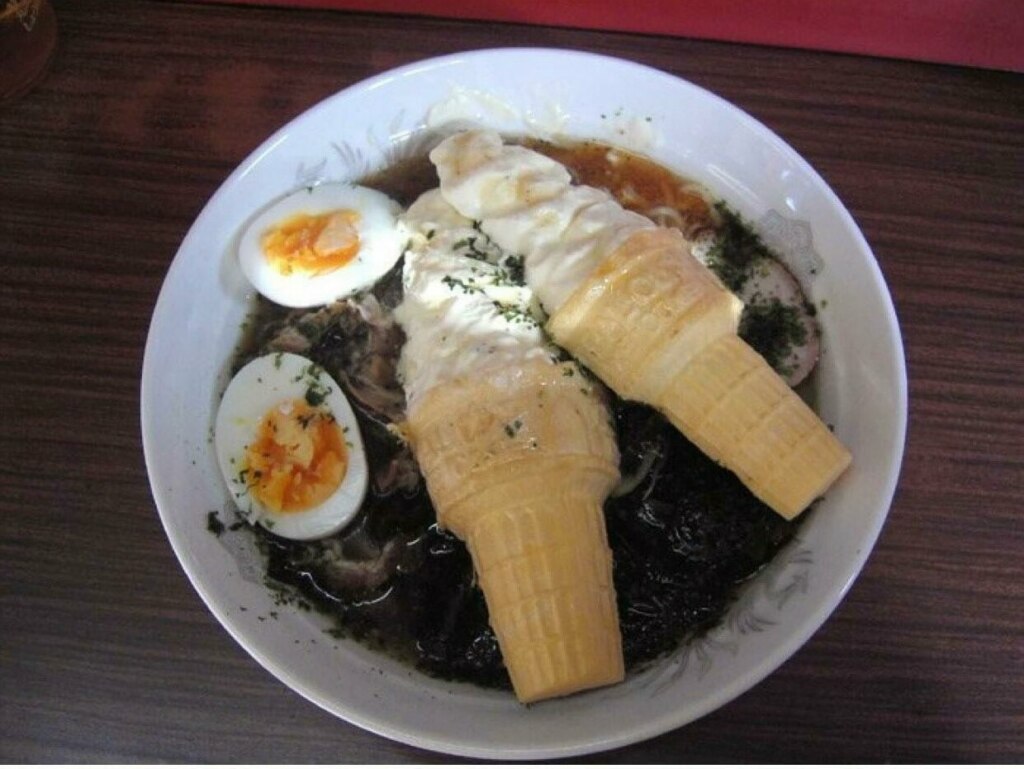
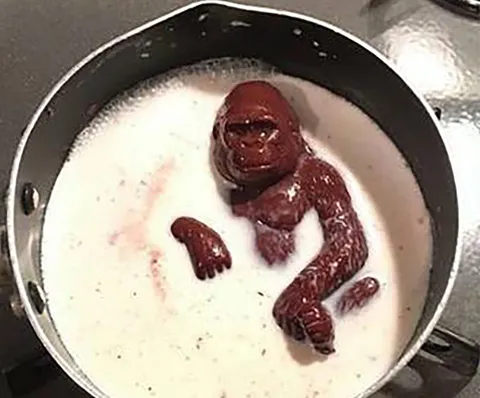
The picture shows a dish in a deep white bowl on a dark wooden table: black broth with dark pieces of seaweed or meat, two halves of boiled eggs with runny yolks, and two waffle ice-cream cones filled with a white creamy mass. The dish looks like a failed culinary experiment.
It cannot be said where the photo came from or who took it, and the link between this particular frame and the history of the joke is not confirmed. Here the caption matters: the picture works as a specimen of “home food” that looks nothing like dinner.
Captions in the same rhythm
First: “Mom, shall we go to “McDonald's”?” — “No need, there's buckwheat at home.” — “Which one?” — “From last week, but it's still there.” The second line sounds like a decision, and the third lowers the stakes: the buckwheat is not simply there, it has been waiting in the pot for several days.
Second: “Shall we order pizza?” — “There's bread at home.” — “Is it fresh?” — “It's crust, but an honest one.” The humor lies in the delicacy with which the parent admits the modesty of the product.
Third: “Maybe we could have dinner at a café?” — “There are pickled cucumbers at home.” — “How old are they?” — “They remember the nineties.” The joke rests on the absurd age of the product.
Fourth, the shortest: “Let's go to a café!” — “There's everything at home.” — “Open the fridge.” A couple of lines move the decision into the frame: the viewer imagines the fridge for themselves.
How to take the template for your own caption
A short dialogue of two or three lines works best, with a last line that is concrete: the name of a product, its age, or its condition. Generic words such as “everything there is inedible” barely have an effect, because the contrast becomes abstract.
If the caption is rewritten for a situation involving work, study, or friends, keep the structure: the proposal, the refusal with a reason, and an unexpected detail. Then the meme stays understandable without explanation, even for those who see it for the first time.