What is visible in the photo
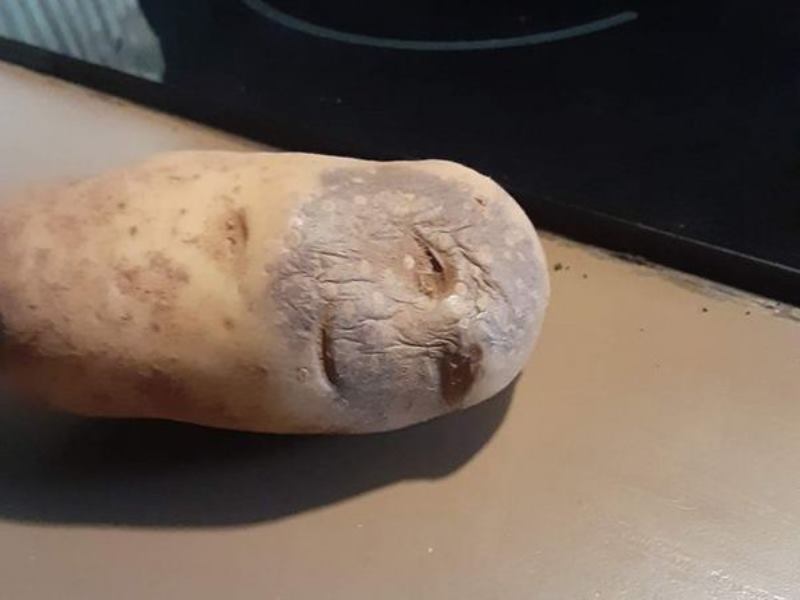
A large tuber lies on a light tabletop in front of a dark wall. Most of the peel is beige with occasional dark specks, but one end is covered in gray film and fine wrinkles. On this patch two dark dents are visible, resembling closed eyes, and one more below that looks like a mouth with downturned corners. Because of this, the potato looks as if it is dozing or feeling sad.
The emotion reads without a caption: no one drew a face; it formed from the natural flaws of the peel and the lighting.
Where the picture came from
The origin of the photo has not been established: open sources contain no reliable information about who took it, where it first appeared, or when. So it is more accurate to treat it as one of the countless amateur photos of “faces in objects” that have long circulated on social media.
This is a normal fate for such memes. A single successful picture is enough for it to be copied and forwarded without credit, and the text versions of the story that circulate in communities are often made up. Only what can be seen in the picture itself is known for certain.
Pareidolia: why we see faces
Pareidolia is the tendency to recognize familiar shapes, most often faces, in random patterns: clouds, stains on a wall, tree bark, car fronts. It is thought that fast face recognition is very important for human communication, so the brain sometimes fires on a few dots and a line arranged like eyes and a mouth.
The potato demonstrates this mechanism well. Two dents at the same level and one more lower in the center: a minimal set is enough for the viewer to see an expression. It also matters that everyone knows potatoes, so the “face” seems funny rather than frightening.
Caption examples
“Monday, 7:40. He didn’t get enough sleep either.” A sleeping expression fits any morning mood.
“When you replied to a message and it was about urgent work.” An expressionless face becomes a portrait of someone who has understood everything.
“Me after hearing ‘we need to talk.’” The pensive potato becomes an avatar of anxiety.
“He knows I ate the last serving.” The joke uses the fact that the face has no clear eyes, so its “gaze” seems accusing.
How to use the template
The picture works well for short captions about mood: tiredness, resignation, pensiveness. The more realistic and everyday the caption, the funnier it is, since the potato remains the most ordinary object on a kitchen table.
Avoid captions that attribute to it someone’s real traits or name a specific person: the joke rests on chance, not on resemblance to a real face.
The “announcement” device also works well: a caption in the style of a work chat or news bulletin, delivered with a completely serious tone (“The potato reported that nothing will happen today”). The dry delivery emphasizes that we are looking at an ordinary vegetable, and the contrast between a household object and an official tone adds bite to the joke.
The less a caption explains, the better: the face is already formed from wrinkles, and extra explanation only gets in the viewer’s way of finding it themselves, and that moment of recognition is exactly what provides the pleasure.