Where the figure came from
The stereotype of the “mom’s friend’s son” took shape in the Russian-language internet in the early 2010s. Social media users began sharing personal stories about how parents or relatives constantly held up some acquaintance as an example: he studies better, plays sports, wins Olympiads, and then earns more than everyone. An article in TJournal cites a 2011 tweet as one early example, but it is impossible to confirm that it was the first.
In the mid-2010s, Pikabu created a separate section for such stories. Some of them directly debunked the stereotype: the “perfect son” turned out to be someone who drinks heavily, drops out of school or changes profession. These very stories showed that the figure originally rested on other people’s accounts and exaggerations, not on real people.
What the picture shows
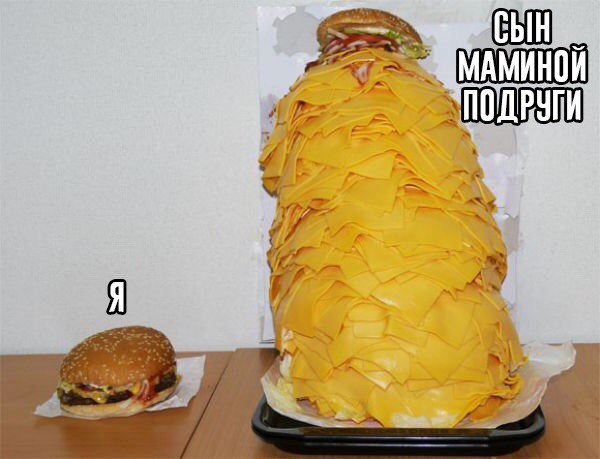
The frame is built on a contrast of scale. On the left, on a light table, lies a small burger with the word “Me” beside it. On the right, on a black tray, towers a huge construction of dozens of cheese slices, with one more burger on top. White lettering “Mom’s Friend’s Son” is set in the upper right corner in large type, in the same style as most captions on Russian pictures of that time.
The author and the place of first publication of this particular image are not established in open sources. It is only known that the picture spread in communities with captions in template form: the top part handles the comparison, the bottom part the narrator’s self-assessment. The cheese burger makes the joke visual but is not its basis; the basis is the gap between two people in the eyes of the one doing the comparing.
The 2018 Surge
A notable surge in popularity came in February 2018. According to the same TJournal, the meme returned to Twitter, and pictures comparing two similar phenomena or two people appeared on imageboards and social networks. The character gradually turned from a household cliché into an almost mythical creature who supposedly always turns out better.
That same month, the newspaper Rossiyskaya Gazeta published a piece headlined “Me and the Mom’s Friend’s Son: A Russian Meme Conquers Social Networks,” showing how far the joke had moved beyond its narrow audience. One of the best-known versions of that period compared the Russian space agency with SpaceX, moving the story from household conversation into public debate about technology and state programs.
How the joke works
The joke rests on several recurring elements. First, the character being compared is always flawless and almost never falls short: he is a top student, an athlete, an entrepreneur and a model son. Second, the narrator almost always takes a modest position, and that modesty itself becomes the object of irony. Third, the comparison usually comes from a relative who wants to motivate the child but gets the opposite effect.
In captions this structure reads easily. For example: “Mom’s friend’s son learned three languages at eight. At eight I learned to open the fridge without it creaking.” Or another variant where the joke shifts toward self-irony: “Mom’s friend’s son already bought an apartment. I’m still learning not to mix up a fork and a spoon at the office party.” Both examples work on the same scheme: the comparison is pushed to absurdity, and the narrator draws the conclusion.
Meaning and limits of the meme
The meme’s meaning changed over time. At first these were personal complaints about a pushy relative and his “perfect” acquaintance. Then the figure became an ironic tool for comparing any two people, companies or phenomena. Later the meme moved into a mode of almost pure hyperbole, where the character is perceived as a symbol of an unattainable standard rather than a specific person.
It is important that the meme is tied primarily to parents who allow themselves inappropriate comparisons. That reading accurately conveys the original sense of the stories but does not exhaust it: many users employ the figure for self-irony rather than as a reproach to anyone. So it is more accurate to speak of a stereotype that mocks both the comparers and the compared, however impressive the “perfect” character may look.
Place in internet culture
The meme remains one of the enduring templates of Russian-language humor. It is used in comments, in messaging, and in replies to others’ praise: one phrase or picture is enough to signal that the comparison should not be taken seriously. The simplicity of the format, with two objects and a caption, makes it easy to adapt the figure to new situations.
For the catalog, the meme is interesting as an example of how a household stereotype turns into a visual code. Its origin is incompletely documented: the author of the first picture, the exact date the template appeared, and the first publication remain unknown. That is why any confident claim about the meme’s “creator” would look like speculation, whereas the history of its spread is confirmed by public sources and surviving pictures.