What's shown in the picture
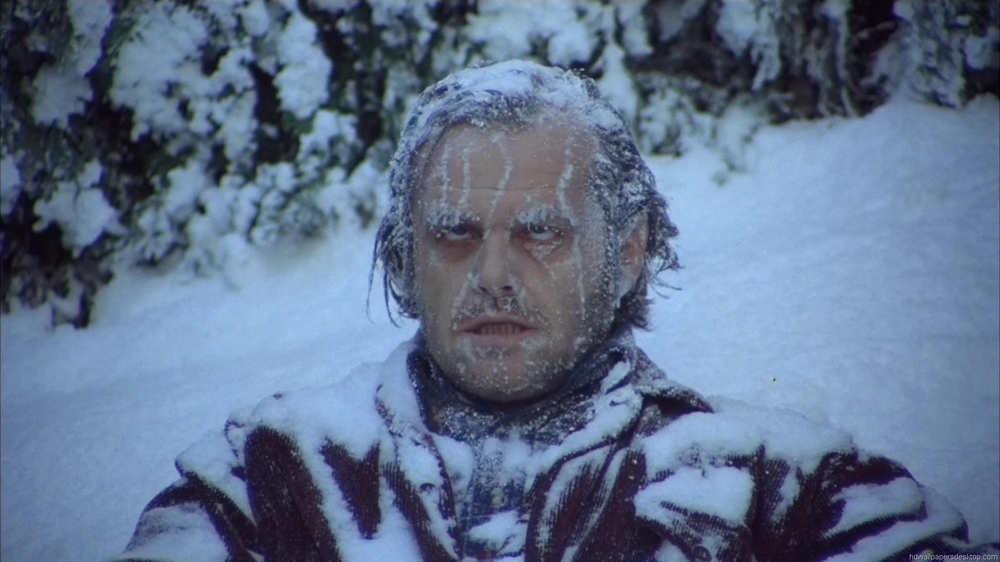
The frame is a close-up of a man's face, his eyebrows and eyelashes white with frost, his hair matted, and white streaks of snow across his forehead and cheeks. His head and shoulders are covered in a crust of snow, with snow-covered bushes and drifts visible behind him. His expression is frozen: mouth slightly open, eyes staring straight into the camera, as if the character is holding on to his last bit of movement.
It's precisely this stillness that makes the image recognizable. The snow covering his body looks so natural that viewers get a sense of real hypothermia, which is why the frame transfers easily into everyday jokes about winter walks without a hat and dressing wrong for the season. The picture speaks for itself and doesn't need a long caption.
Origin
The frame is taken from the ending of The Shining, Stanley Kubrick's adaptation of Stephen King's novel, released in 1980. At the climax, Jack Torrance, chasing his son through a hedge maze at a snowbound resort, freezes to death, and the camera lingers on his snow-covered body. It's this scene that became the source of the template, since viewers remember the film's grim, almost supernatural ending well.
The image became a meme around the early 2010s, when forum and social-media users began using it to describe cold and winter discomfort. The exact date of the first post and the author of the first caption have not been established in open sources, so there's no talking about a specific creator of the template. It spread through the usual internet channels: comments, reaction images, and communities devoted to film and humor.
How it's used
A typical caption accompanies the frame with a brief description of the feeling: "Went outside at minus thirty with no hat" or "Me, realizing the bus is still forty minutes away." The image is also used ironically, in reference to icy sidewalks, a cold office because of the air conditioning, or waiting for a bus in the wind, where every minute feels like an eternity.
The meme also often plays on the transition from warmth into the cold: the character in the frame seems to symbolize someone who enthusiastically decided to take a winter walk and instantly regretted it. Such captions create a sense of dramatic exaggeration behind which lies a completely mundane inconvenience, which is why the template works well in messages and under photos of winter landscapes.
Why the meme works
The joke rests on the contrast between recognizable, almost cinematic horror and a thoroughly mundane occasion. The viewer knows the film's ending and understands the character died, so using this image for ordinary cold creates a hyperbole that is funny and slightly unsettling at once. The more dramatic the caption, the stronger the effect.
Beyond that, the frame is expressive and understandable without explanation, and its visual code — a white background, frost, and a frozen face — reads easily in any context. Thanks to this, the template has outlived the original film and become a universal label for complete surrender to winter, something familiar to anyone who has ever waited for a bus in the cold.