How fantasy became a map of habits
The family took shape as a noticeable wave in late 2017 and January 2018. Among the early known variants was a remake of Nightcrawler by Boris Groh: a huge skeleton was given the name of a night person, and a small figure was assigned a bag of grated cheese. The dark scene became a story about a trip to the fridge. This example shows a device that was already working, but it does not establish a single inventor of captions on fantasy pictures.
In January 2018, such collages were regularly published by the Instagram account youngbottomtext, which used, among other things, works by the artist mr_werewolf. The variants spread to Tumblr and Reddit, and a discussion around PewDiePie widened the audience. The pictures, captions, and number of participants changed. Therefore the name unites a whole method of remaking: the defining element was the conflict of disproportionate forces, not one permanent character or a specific universe.
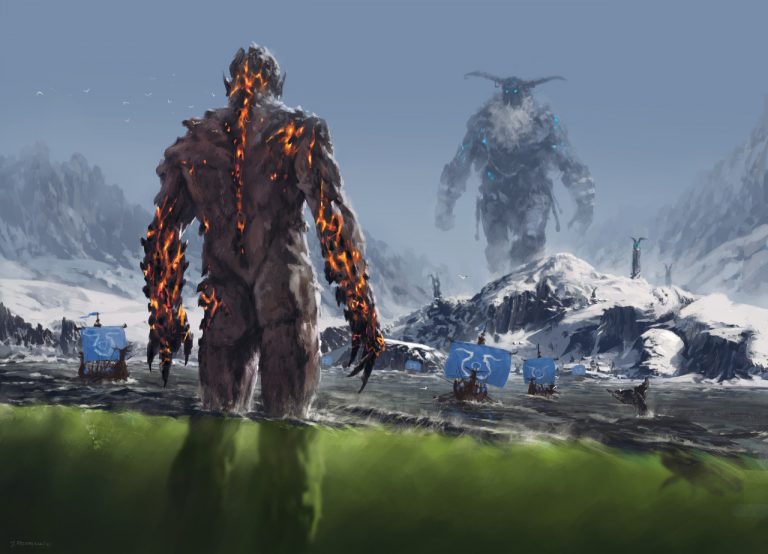
Two giants above small boats
In this illustration, a dark giant with glowing orange cracks rises from the water on the left. Further right stands another gigantic figure: gray, horned, with blue glowing areas. Between them there are snowy cliffs, and at the surface of the green water are tiny boats with blue sails. The name of the artist of this exact scene has not been established; it cannot automatically be credited to the author of the early skeleton meme.
There are no captions here yet. This allows the roles to be distributed differently: making the two giants rival circumstances and the boats the people between them, or setting the whole small flotilla against a single monster. The foreground monster seems especially close due to the reflection in the water and the bright fire. The distant giant adds a second source of threat: the small participants are cramped even in a vast open space.
Scale instead of a long explanation
Captions change the meaning of the picture while preserving its relations. A large object signifies a force that seems insurmountable; a small one expresses limited resources. The giant could be labeled “deadline,” but the sense of urgency is conveyed by the size difference alone. A few words connect with ready-made drama: distance, poses, direction of movement, and the place of the weak participant.
What is funny is the mismatch between an everyday reason and a solemn image. In the artwork the boats are presumably taking part in a dangerous adventure; in the caption they may be saving the last free Saturday. Two large opponents make a more complex joke than a simple victory of the strong over the weak. A person may fear several demands at once, choose between desires, or discover that a modest plan has ended up at the center of someone else's struggle.
What forces might collide
In an invented variant, the lava giant is captioned “urgent project,” the gray one “accumulated household chores,” and the boats “my day off.” Both threats look independent, so the joke promises no rest even after defeating one of them. The space between the monsters becomes the only place where a personal plan still fits.
Another invented version depicts the flotilla as “three closed tabs,” the first giant as “a new search topic,” and the second as “recommended videos.” A small achievement is visible, but the scale of the next wave already makes it insufficient. In a third example, the monsters are captioned “want to travel” and “want to lie at home,” and the vessel as “one free evening.” Here the giants stand for the person's own desires, not external enemies. The same composition turns from a defense against circumstances into a comic struggle of a person with incompatible plans.