What the picture shows
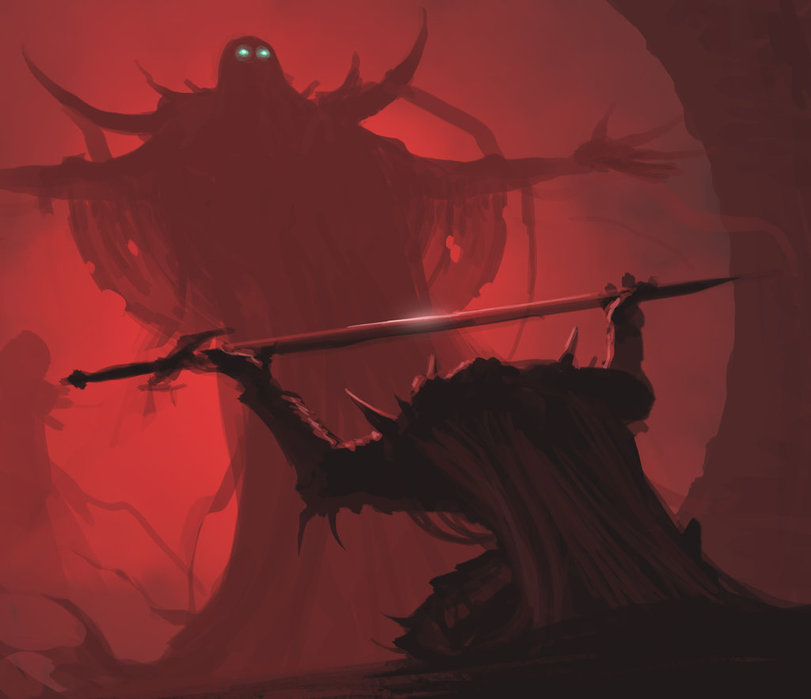
The picture is done in a dark red palette. In the depth of the frame towers a huge figure with its arms spread wide and horn-like projections on the sides of its head and on its shoulders. Its eyes glow a green-turquoise color, which is the only bright accent against the background. On the left, in the background, another vague silhouette can be made out.
In the foreground, at the bottom right, is a kneeling warrior in spiked armor. He holds the sword horizontally across the frame with both hands, at chest level, as an offering, and a light glint runs along the long blade. The warrior's figure is lowered, the pose is restrained, and the whole composition looks like a solemn moment of reverence.
Who drew the picture and where it came from
According to available information, the work is called “Master's Blessing” and was posted on an art platform in 2016. The author is named as the Spanish artist Diana Franco. In her words, the drawing was made quickly as part of an assignment in a closed group, where participants were given limited time, and the theme gave the title.
These details come from the artist's own statements and are not confirmed by independent documents, so they should be treated with caution. Sources also disagree on exact dates: they mention an upload in 2016 and the mass spread of the meme in 2018, but not a specific day when the joke appeared.
How the picture became a meme
According to reviews, one of the early known uses of the template was a caption on a meme site in 2018. In the autumn of that year the picture was noticed on Reddit, including in communities devoted to wholesome memes, and then it spread to other platforms. These are examples found, not a proven chronology.
The template's mechanics are simple: captions are written for three elements. The kneeling figure is the one who brings, the sword is what is brought, and the shadow is the one to whom it is given. That is why an ordinary thing, such as a stick for a dog or a mouse for a cat, becomes a solemn offering. The dark red color and the gloomy figure make the contrast with everyday content especially noticeable.
Why the joke works
The core of the joke is the mismatch between genre and content. The picture looks like a scene from a gloomy fantasy: red light, a huge creature, a weapon as a gift. The caption, however, talks about pizza, a screwdriver or a report. The lower the significance of the object, the higher the pathos of the pose, and the funnier the result.
An additional plus of the template is the freedom of roles. The shadow can be a boss, a hungry friend, a child, or luck itself. The one who brings always looks submissive, and this adds self-irony: the author of the caption usually plays the role of this warrior.
Caption examples
Four captions invented for the template. Each links the shadow to someone familiar, the sword to an offering, and the warrior to the person bringing the gift.
Warrior: “Me, who came with my paycheck.” Sword: “Pizza.” Shadow: “The friends who promised to chip in.” Here the joke lies in the shift of value: a solemn pose goes to the most ordinary act.
Warrior: “Me, who fixed the outlet.” Sword: “A screwdriver.” Shadow: “The one who will ask how much it cost.” The second half of the caption flips the expectation, and it becomes clear that the ritual is about acknowledgment.
Warrior: “The first slice of cake.” Sword: “A spoon.” Shadow: “The kid who swore not to touch it.” The contrast between the pathos of the pose and the small object explains why the captions come out short.
Warrior: “The question about vacation.” Sword: “A notebook with calculations.” Shadow: “The boss on Monday morning.”
How to use the template
The template works best when the pathos of the pose and the ordinariness of the object diverge sharply. If the caption explains too much, the effect disappears, so three short roles are enough: who gives, what is given, and who receives.
The shadow in the picture has no human features, so the caption can describe either an object or a situation. The clearer the roles, the faster the viewer gets the joke without explanation. Do not caption the shadow with real people in a demeaning way: the template works as a gesture of reverence, not as a tool for bullying.