What's shown in the picture
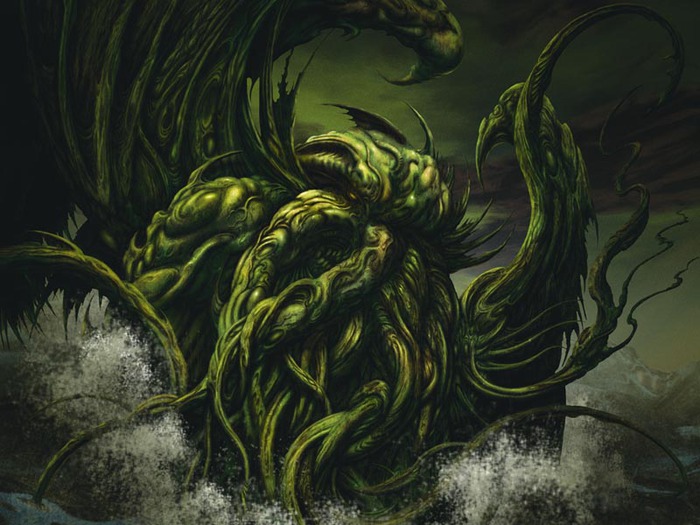
The illustration shows a huge greenish creature covered in tentacles, ridged growths, and wing-like appendages. The monster's head and shoulders rise above the water, and gray clouds of spray swirl near the horizon. The dark sky with its grim glow makes the scene feel ancient and hostile, which accurately conveys the atmosphere of the literary source.
The illustration's author is not listed in the meme's card, and it couldn't be identified from the image itself. The meme doesn't rely on a specific image but on the character and his name: captions pair with any drawing of Cthulhu, so the picture serves more as an illustration than as the source of the joke.
Literary origins
Cthulhu was created by the American writer Howard Phillips Lovecraft. The story "The Call of Cthulhu" was written in 1926 and published in Weird Tales magazine in 1928. In it, the ancient being sleeps in the sunken city of R'lyeh at the bottom of the ocean and may one day awaken, with people utterly insignificant before this horror.
The text's most famous detail is the incantation "Ph'nglui mglw'nafh Cthulhu R'lyeh wgah'nagl fhtagn," roughly translated as "In his house at R'lyeh, dead Cthulhu waits dreaming." Lovecraft's followers, August Derleth chief among them, systematized the "Cthulhu Mythos," and in 1981 the Call of Cthulhu tabletop game was released, cementing the image in mass culture.
The path into the internet
The meme's card lists 2006 as when it appeared online. The first waves of popularity are tied to fans of science fiction, role-playing games, and horror, who traded pictures and parodies on forums and image boards. The specific first post or picture that started the joke hasn't been identified, so an exact place of origin can't be named.
Over time, the phrase from the incantation became a standalone internet joke. People wrote it out deliberately garbled, and Cthulhu himself turned up in comics, parody videos, and image captions. The addition of "fhtagn" at the end of lines became especially recognizable, and for anyone familiar with the fandom it instantly reads as a reference to the ancient god.
How the meme is used
Most often Cthulhu is invoked to mean "some unknowable crap": when something incomprehensible, strange, or flatly nonsensical happens. The caption might read "someone summoned Cthulhu again" or "that's clearly not from our world." This format is handy for talking about glitches, baffling news, and situations where there isn't enough explanation to go around.
The humor rests on contrast. A cosmic monster with tentacles gets paired with a mundane caption, and the gap between the grandeur of the image and the triviality of the occasion creates the comic effect. The user essentially admits they've run into something not of this world and turns their bewilderment into a joke rather than a complaint.
Why the meme endures
The main reason for its staying power is how expressive the image is. Cthulhu is simultaneously ancient, frightening, and completely alien, which makes him easy to use as a metaphor for any incomprehensible phenomenon. The unfamiliar name is hard to pronounce on the first try, and that too feeds the joke: people distort it, simplify it, and play with it.
The meme has also been fed by Cthulhu's popularity in games, books, TV shows, and merchandise. The creature has appeared in video games and board games, and each project added to his recognizability, so even someone who's never read Lovecraft understands a caption about "some unknowable crap" when they see the green monster.