Who drew it and when
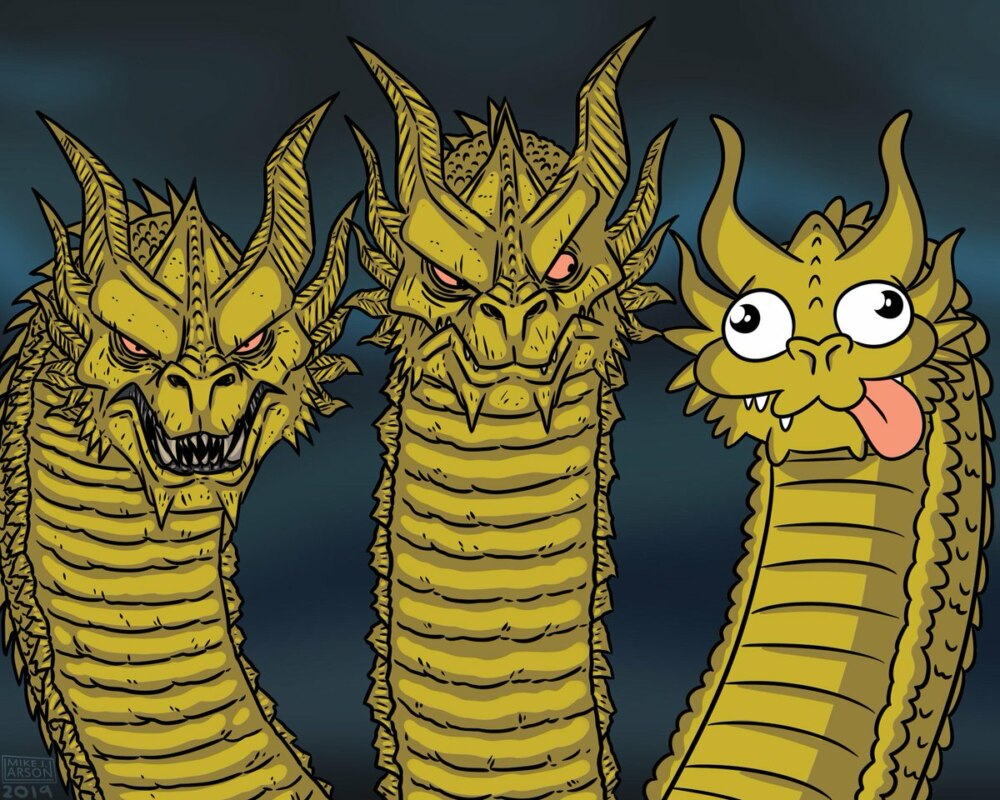
In the bottom left corner of the drawing is the signature “Mike Larson 2019”. According to data on early publications, the work titled “King Ghidorah in a Nutshell” appeared on the DeviantArt art platform on 2 June 2019 under the username MichaelJLarson. This username matches the signature on the picture, but the author’s full name is not confirmed by the username, so it is most reliable to refer to the signature on the drawing itself.
The date 2 June 2019 is the earliest known publication, not a proven day the drawing was finished. The film had come out only a few days earlier, at the end of May 2019, so the drawing responded quickly to the novelty.
The film the joke grew out of
“Godzilla: King of the Monsters” came out in 2019 and was a sequel to the 2014 “Godzilla” in the shared cinematic universe. The film was directed by Michael Dougherty. King Ghidorah is a three-headed dragon antagonist, and its heads became a ready-made structure for jokes. For captions you don’t need to know the plot: it is enough that the creature has three heads and each looks different.
Around the film there was lively fan discussion. On 2 June 2019 a thread appeared on Reddit where viewers asked who else calls one of Ghidorah’s heads Kevin. A few days later the director tweeted that during filming two heads were called the Japanese words “Ichi” and “Ni”, meaning “one” and “two”, and the third was called Kevin. Which head was called Kevin viewers still debate, so in captions it is more reliable to rely on the visible character of the heads than on their names.
Three heads and their personalities
In the drawing, the left head looks menacing: sharp horns, reddish eyes and a mouth full of teeth. The middle one is also angry, with pinkish eyes and a heavy crest. The right head is quite different: large white eyes with black pupils, a protruding pink tongue and a good-natured little face. The background is dark blue, which emphasizes the contrast between the serious heads and the cheerful one.
The joke rests exactly on this difference: three heads belong to one creature but behave like three different people. The first two heads look as if they fully control the situation, while the third clearly doesn’t understand what is happening, and is happy about it.
Caption examples for three heads
The examples below are invented to illustrate the mechanics and do not refer to real people.
“Left head: ‘I’m in charge of the plot.’ Middle: ‘I’m in charge of everything else.’ Right: ‘I’m just glad to be here.’” The joke works through the distribution of roles: each head gets its own job title, and the contrast between seriousness and good nature produces the laugh.
“Left: ‘You weren’t supposed to see this.’ Right: ‘Oh, really? Interesting.’” Here expectation shifts: the first line sounds threatening, and the second dissolves the tension with simple curiosity.
“Monday: left head checks email, middle one swears at email, right one drinks coffee.” Three actions show three attitudes toward one task, and the last item breaks the expectation.
In each variant the caption relies on the visible difference in facial expression: if a head looks good-natured, its line should be gentle, otherwise the joke falls apart.
Where this template works
The template suits memes about the distribution of roles in a group, about different approaches to one task, or about disputes where everyone is sure they are right. It is poorly suited to complex reasoning: three short lines read quickly, while long texts lose the rhythm.
The more the voices of the three heads differ, the better the caption works. A good device is to leave the right head the shortest and most naive line: it serves as the final remark and closes the joke.