What the meme looks like
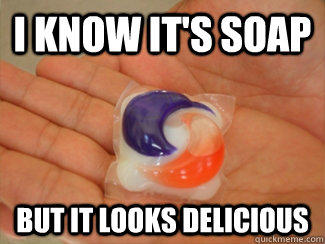
The photo shows a hand holding a single pod in clear film. Inside the pod, blue-violet and orange sections are separated by white streaks, which makes it look like a lollipop. The top caption is in capital letters, “I KNOW IT'S SOAP”; the bottom one reads “BUT IT LOOKS DELICIOUS.” A watermark from the site where the image was spread sits in the corner. The shot is simple and unstaged, so the caption does almost all the work.
This is a classic macro template: the top line acknowledges the obvious, and the bottom line overturns it with feeling. The joke rests on the contrast between common sense and desire.
Tide Pods and their appearance
Tide pods appeared on the market in the early 2010s as a convenient dosage form for detergent. Their look made them resemble sweets, which alarmed parents and safety specialists. That became the basis of the meme: the product looks edible although it is meant only for laundry.
This needs to be handled carefully. The joke sits on a real risk to children and to people with behavioral disorders, and medical publications have described such cases in detail. The meme should therefore not be read as a call to do anything, only as a reaction to the dangerous appeal of the packaging.
The Tide Pod-tan character
There is a character called Tide Pod-tan who personifies the detergent. The suffix “-tan” is borrowed from Japanese culture and, in online speech, denotes a character in a female form. Details of the character's appearance and origin are not established. It is known that such personifications spread in anonymous communities and on image boards, where the brand turned into the hero of comics and reaction images.
Figures like this help a meme move beyond a single picture: the character gets a personality, and the joke carries on through drawings, captions and conversations.
Tide Pod challenge and the real risk
In early 2018 the so-called Tide Pod Challenge spread in the US: people filmed themselves eating pods and posted the videos online. The press, medical experts and the manufacturer itself urged people to stop, because swallowing the detergent led to serious consequences, including poisoning and the need for hospitalization. The line between joke and real harm turned out to be very thin, and many outlets stressed that the meme was not harmless.
The meme is a joke, not an instruction, and that matters: the description must not sound encouraging. The topic remains an example of how slang and viral mechanics can spill out beyond the internet.
Example captions
The structure “I know it's X but it looks Y” works for anything that defies common sense yet attracts. For example: “I know it's Monday, but it looks like a day off.” The second caption shifts to an everyday situation: “I know it's a chat with my boss, but it looks like a reason to take a break.” Such captions keep the core tone: first the obvious is admitted, then it is dismissed with emotion.
The format also works without the pod picture, because it relies on a recognizable logic.
In memes like this, the pause between the two lines matters too: the top sets the frame, and the bottom breaks it. If you cut the caption down to one word, the effect disappears, because the viewer is already sure of the obvious. Keeping two lines is therefore not an accident but a condition of the genre. The format also allows swapping the object: instead of a pod, any item with a similar visual deception can be used, though the original remains the most recognizable. That is why the phrase outlives the photo itself and often appears in messages as a short reaction.