What is in the frame
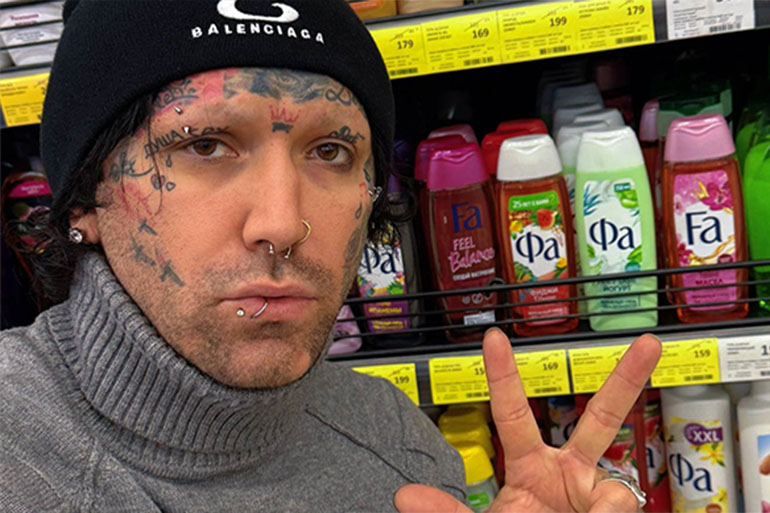
The illustration for the meme is a supermarket selfie: a man with facial tattoos and piercings in his nose and lip, wearing a black cap with the white lettering BALENCIAGA and a gray chunky-knit turtleneck, raises his hand in a V sign. Behind him is a shelf of Fa shower gels, with pink, green and light blue caps and yellow price tags with numbers like 169 and 179.
The shelf of “Fa” works as a pun: one of the meme’s key words literally stands behind the hero. It is the best detail of the picture, because it explains the joke without a single note.
How this language came about
From September 2025, Gunwest signed the posts in his Telegram channel with random sets of these words, and in videos and “circles” (round video messages) he said them every other sentence. At the same time he changed his image: a leather jacket, white paint on his face, punk spikes, later black makeup. The point was not the words but irritation: the rapper explained that he was distorting foreign vocabulary into a parody of the “vaipers”, a youth movement around Kai Angel and 9mice.
Part of the audience seriously decided that the musician had lost his mind; most simply picked up the game. By January 2026 this set of words was already being called the first big meme of the year.
What each word means
Gunwest invented the meanings after the words had already spread, and in different interviews he retold them differently, hence the variations in spelling: “shneyne”, “shnele”, “shney”.
Pepe (pronounced “peh-peh”) is either “papa” or Pepe the Frog; the rapper insisted on the latter and said the frog attracts money while Peppa Pig does not. Shneyne is a distorted Chanel, a synonym for luxury. Fa is a calque of an English expletive, suitable both as agreement and as an exclamation. Vtfa (vatafa, votofo) is the same expletive with the question word “what”, the extreme degree of displeasure. Fo is a calque of that same English expletive without the question prefix. A separate item is “kheh-kheh”: the rapper coughed while recording a track, and the sound was left in the final version.
How it spread
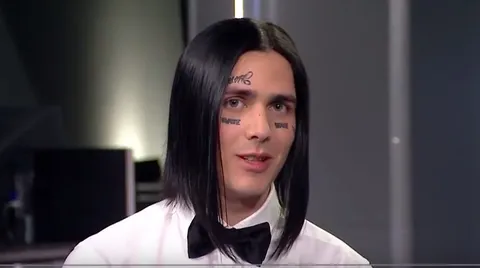
The brainrot mechanism worked: short absurd formulas are easy to repeat. The words were fitted into the tongue-twister about the Greek (“Yekhal Greka cherez reku”, a Russian rhyme about a Greek riding across a river), producing “yekhal pepe cherez shneyne”, and then into Pushkin’s “I remember a wondrous moment”: in a video the rapper, with Pushkin-style curls, reads the reworked text over a sad rap melody.
Then Dota players and schoolchildren joined in: the set of words was used to describe anything, from War and Peace to a person’s state in the middle of the New Year holidays. Gunwest released the tracks “Vika Loves PEPE” and “coding/shneyne”, launched merch with cryptic phrases, and brought this lexicon to the shows “Kstati” (“By the Way”) and “Chto bylo dal’she?” (“What Happened Next?”).
What is confirmed and what is retold
The origin differs from one publication to another. Some outlets retell the rapper’s own version, that the words came to him in a dream; one retelling features a “man in white” who ordered him to say these sounds for luck. Earlier and more detailed accounts have no such episode: they speak only of a parody of the vaipers and of imitating sounds.
Sources also differ on where exactly Gunwest gave his decoding: “Kstati”, “Utro. TNT” (“Morning. TNT”) and “Chto bylo dal’she?” are all named. What the sources agree on is something else: the words appeared before the meanings, and the meanings were invented after the fact. There is no single translation of “fo vatafo shneyne pepe”: it is not a line from a song or a quote, but a random combination that the author assembles anew each time.
Captions that work
“Bought shower gel and feel like the owner of a department.” It rests on a real detail of the frame, the shelf of Fa, and on the word “fa”: grand talk about wealth collides with the price tag on the bottle.
“Yekhal pepe cherez shneyne, vidit shneyne, v reke fa.” There is nothing to understand here: the rhythm of the tongue-twister known since childhood carries the phrase by itself, and the absurdity only strengthens the effect.
“Handed in the report. Pepe. Shneyne. Vtfa.” Three words replace the whole emotional journey of a workday, and the “vtfa” at the end works like an exhale.