The brand and its style
Burger King is an American fast-food chain founded in 1953 in Miami. It has operated in Russia since 2010 and is known for a provocative promotional style: the company readily replies to users, jokes at competitors' expense, and uses the audience's own inside jokes. This approach made it one of the most visible brands in the Russian digital space.
The social-media team, by most accounts, is run by someone who knows internet memes well, so the brand's advertising is often built not on a conventional product pitch but on recognizable formulas. Each new promotion from the chain becomes a talking point, and sometimes a point of controversy. In this model the ad itself becomes the subject of conversation, and its effect is measured not just in sales but in how often users write about it.
The banner itself
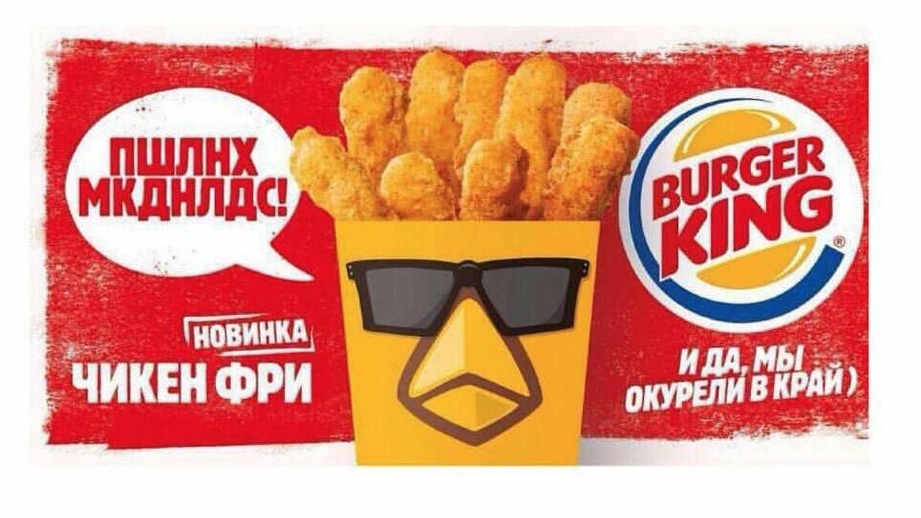
The banner shows a cup of Chicken Fries potato-shaped nuggets with a yellow beak in sunglasses peeking out of it. On the left is a white speech bubble reading "Get lost, MCDNLDS!", on the right is the Burger King logo, and at the bottom is the tagline "New: Chicken Fries." The background is done in red brushstrokes, which makes the composition bright and eye-catching in a feed.
The line "Get lost, MCDNLDS" is built on a play on words. The abbreviation MCDNLDS, spelled out with consonants only, stands for the rival's name, McDonald's, while the dismissive phrasing mimics a crude "get the hell out." The tagline "And yeah, we've lost our minds" adds self-deprecation: the brand admits its behavior looks brash, and it's doing it on purpose.
Origin and spread
The banner is dated to 2017, but the exact publication date, the author of the design, and the first platform it appeared on could not be established. The format of jokes written with consonants only, which Russian-speaking users used to spell out brand names, existed online long before this ad, and the marketers picked it up as a language the audience already understood.
The picture quickly spread across social networks, forums, and news feeds, where it was discussed as an example of a brand "trolling" a rival. What matters is that the meme lives on independently of the promotion itself: users kept and forwarded the banner even after the specific offer stopped being relevant. Many commenters noted that the joke's form itself became recognizable: writing a few consonants and tacking on an assessment like "lost our minds" was enough for the text to instantly read as an ironic jab at a competitor.
Reactions and context
Campaigns like this regularly provoke mixed reactions. Part of the audience sees wit and the ability to speak the same language as young people in them, while another part sees them as crude and as an attempt to step outside the bounds of normal business communication. Both viewpoints help explain why the banner became so visible: it provokes, but it doesn't slide into outright aggression toward people.
The meme matters as an example of advertising turning into internet folklore and outliving the promotion itself. For the brand, it's a way to hold the audience's attention, and for users who know the context, it's a reminder of the style that defined Russian digital marketing of the 2010s.